


Effective last-mile route planning integrates planning, dispatch, execution, and performance data into a single system. The seven features below show what to look for and how each capability supports daily operations.
Why generic route planning tools fall short for last-mile fleets
Generic tools tend to optimize for distance or estimated travel time. Last-mile operations face a larger set of connected decisions. These include:
- Which depot should serve an order
- Which vehicle can carry it
- Which driver is eligible
- When the customer can receive it
- Whether the route remains feasible as conditions change
These decisions quickly stack, making route planning much more complex than distance traveled. A generic tool will soon start to fail when things change during the day.
First, static plans start losing value as soon as traffic, demand, staffing, or customer availability changes. Second, separate systems for vans, bikes, and walking carriers create fragmented plans and limited network visibility. Third, weak integrations force dispatchers to manually move information between order, telematics, driver, and customer systems.
This means dispatchers must rebuild routes by hand, drivers receive outdated instructions, and managers cannot compare the plan with what is happening on the road. A purpose-built dynamic routing platform reduces handoffs, keeping decisions connected to real-time information throughout the day.
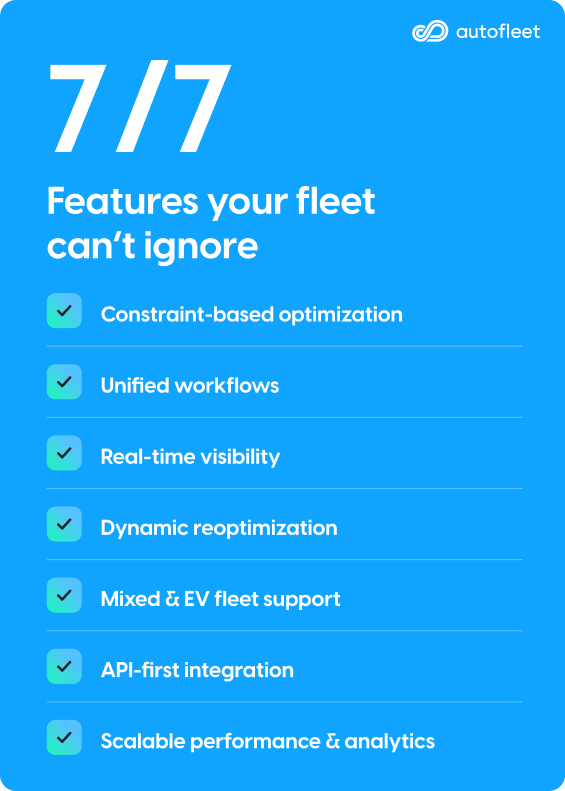
7 critical features your last-mile fleet needs
1. Advanced constraint-based optimization
Every operator has rules that shape a feasible route. These often include:
- Vehicle capacity
- Parcel weight and dimensions
- Delivery windows
- Driver shifts and breaks
- Service times
- Refrigeration
- Driver certifications
- Depot cutoffs
- Customer SLAs
The platform should optimize all relevant constraints at once, rather than applying them after routes have been created.
Look for software that supports customizable constraints across planned, on-demand, and mixed services. This allows operators to balance KPIs such as on-time performance, miles driven, cost per delivery, and utilization. Ask vendors to demonstrate a difficult route set using real operating rules, since simplified sample data reveals little about production performance.
2. Continuous reoptimization and dynamic dispatch
A morning plan is a starting point. Strong last-mile delivery software should continue evaluating routes as new orders, traffic, cancellations, delays, and staffing changes affect the network. It should determine whether to resequence stops, reassign work, consolidate loads, or dispatch another vehicle without forcing the team to rebuild every route.
The platform should combine dynamic route optimization with automated dispatch and updated arrival windows. Dispatchers can respond to disruption while customers receive ETAs that reflect current conditions. When evaluating, test how quickly the platform reoptimizes, which constraints it preserves, and how much control dispatchers retain.
3. Unified multimodal and EV routing
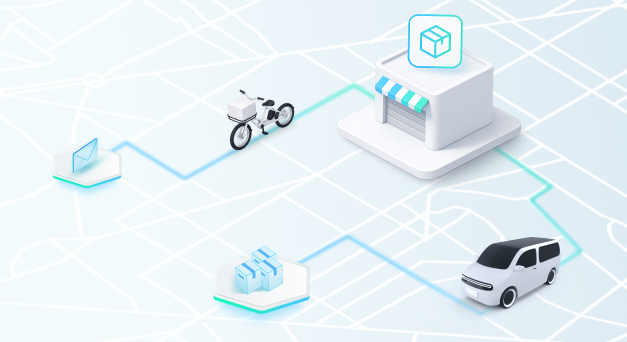
Vans, cargo bikes, mopeds, walking carriers, and electric vehicles (EVs) cannot be planned as interchangeable resources. Each mode has different capacity, speed, access, parking, road, and energy constraints. The software should identify the appropriate mode, coordinate handoffs, and optimize driving and walking segments as part of a single network plan.
Autofleet supports multimodal routes and mixed fleets, including mode-specific routing and EV requirements. Planning can account for:
- State of charge
- Usable range
- Charging stops
- Payload
- Weather
- Terrain
Operators adding electric trucks can use EV routing to define the data and constraints needed before rollout. For more on coordinating modes, read our article on Multimodal Routing for Last-Mile Operators.
4. Custom maps, geofencing, and precise drop points
Public road maps do not contain every rule a delivery fleet needs. Routing may need to account for:
- Pedestrian zones
- Low-emission areas
- Curb restrictions
- Unsafe turns
- Private roads
- Loading points
- Building entrances
- Paths available to bikes or walking carriers
All these variables need to be considered to ensure delivery rate remains high. Poor address data can also send a driver to the wrong side of a large building or business park, impacting delivery times.
Look for software that allows operators to add GIS layers, define geofences, apply vehicle restrictions, and edit precise drop-off points. Drivers can save corrected locations, while planners can visualize performance by geography. The routing layer improves as teams add to this operational knowledge.
5. Live operational visibility and exception management
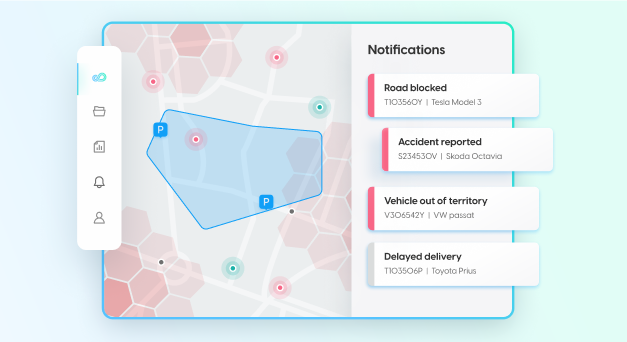
Dispatch teams need to see vehicle locations, route progress, delivery status, and risks to service windows from one control point. Alerts should identify late routes, failed delivery attempts, vehicle issues, and other exceptions early enough for the team to act. Plan-versus-actual tracking also helps managers separate isolated disruption from recurring planning problems.
Autofleet provides live GPS tracking, delivery status visibility, alerts, and updated ETAs. Proof of delivery can include signatures, photos, notes, and documented exceptions such as access issues or customer refusals. This gives the operator a consistent record for each stop and supports proactive customer communication through tracking links and revised arrival windows.
6. API-first integration and workflow automation
The routing platform should fit into the wider delivery stack. Order data may come from a TMS, ERP, WMS, depot system, or external demand source. Telematics provides vehicle location and status, while driver apps, parcel tracking, proof of delivery, and customer notifications support execution. Manual transfers between these systems slow decisions and introduce errors.
Look for an API-first architecture to connect operational data sources and third-party systems. With this, orders automatically enter planning, dispatch decisions reach drivers, and execution data returns to the control tower. When making your decision, evaluate APIs, webhooks, data latency, authentication, support, and ownership of failed transactions.
7. Scalable planning, simulation, and performance analytics
The platform must remain responsive as the operation expands across more stops, drivers, depots, days, and service types. Look for software designed to scale from hundreds to millions of daily deliveries, supporting seasonal demand and complex enterprise operations. That scale should apply to both optimization speed and the operational controls used to manage the output.
Analytics should then close the loop between decisions and results. Make sure you are able to track:
- On-time delivery
- First-attempt rate
- Miles per stop
- Cost per delivery
- Route duration
- ETA accuracy
- Utilization
- Panning time
- Plan-versus-actual performance
When it comes to planning, fleet simulation can help teams test fleet size, depot strategy, mode mix, and demand changes before committing resources. Autofleet's guide to AI capabilities for last-mile fleets explains how optimization and forecasting support faster, lower-cost scaling.
How to choose the right route planning platform for your fleet
Start by documenting your delivery types, daily and peak volume, depots, modes, vehicle rules, driver rules, service windows, dispatch model, and current sources of disruption. Then rank the constraints and workflows that have the greatest effect on cost and service.
Use a representative data set for the evaluation. For example, you might include:
- High-volume days
- Difficult addresses
- Several vehicle types
- Tight windows
- Common dispatch changes
Ask your shortlisted vendors to show how route planning works, how the platform responds to an exception, and how it reports the outcome. The demonstration should also show how the optimization engine evaluates constraints and tradeoffs.
Set baseline KPIs before the pilot and agree on the measurement period. Check implementation requirements at the same time, including integrations, data preparation, user permissions, security, training, support, and the process for changing constraints after launch.
Autofleet is a strong fit for high-volume and multimodal operations because it connects advanced planning with real-time reoptimization, dispatch, live control, custom mapping, proof of delivery, integrations, and analytics. That combination gives teams a single last-mile delivery management platform for planning the day, managing disruption, and improving the next plan.
Book a demo to see how Autofleet can support your route planning.


Table of сontents
.avif)

