
Fleets have a long tradition of operating a certain way, but more and more demands are being placed on them, with additional constraints and requirements. This requires a new way of thinking, and new tools at the disposal of fleet managers mean
Luckily, the increasingly connected way fleets operate means they now sit at the center of a broader operational system, enabling continuous coordination among vehicles, drivers, demand, tasks, vendors, charging, and service commitments.
Fleet managers today need to go beyond oversight to operations that can make decisions and act on them. Here are five things fleet operators need to know about how things are changing.
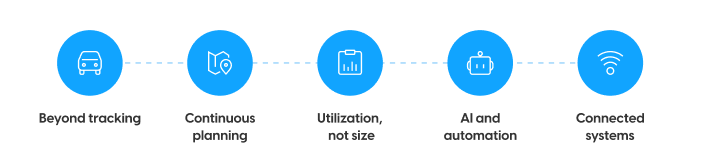
1. The job has outgrown vehicle tracking
Traditional fleet responsibilities haven’t disappeared. Operators must still manage vehicles, handle maintenance, monitor energy use, and ensure SLA compliance. However, those responsibilities are now part of larger operational decisions. As well as vehicle location, fuel level, and maintenance needs, fleets must consider:
- Current and forecasted demand
- Vehicle availability and condition
- Driver skills, shift patterns, and working hours
- Depot, workshop, and vendor capacity
- Customer time windows
- Service commitments
- Charging requirements for electric vehicles
Traditional fleet management platforms are not built to manage these operational variables. Modern fleet management means tracking becomes just one input, rather than the entire operating model, and the fleet management optimization platform considers the whole operating picture before recommending the best response.
2. The operational pressures forcing a rethink
Many fleet processes were designed around predictable demand and periodic planning. Traditionally, routes were created before the start of a shift, maintenance followed fixed intervals, and exceptions were handled manually as they arose.
With the introduction of ride-hailing, same-day delivery, and multimodal transportation, conditions are growing more complex for all types of fleets. This makes a traditional approach harder to sustain, especially when you consider how costs are increasing across labor, insurance, maintenance, energy, and infrastructure.
Logistics UK said that in the year to April 2026, vehicle operating costs had risen 12%. This is driven up by diesel costs, but also includes a 7% increase in insurance and 8% in driver wages. The global picture is very similar with haulers, last-mile fleets, passenger transport, and rental firms all similarly affected.
This means margins are being squeezed and every efficiency gain counts. Continuous decision-making can counteract these rising costs by seeking the most efficient way to serve customers while minimizing fuel and energy use. Reducing deadhead miles and increasing utilization can help widen those margins.
The challenge is in keeping the plan feasible as traffic, cancellations, breakdowns, urgent requests, and vehicle availability change throughout the day. This requires continuous decision-making that adapts accordingly.
3. Productive capacity matters more than fleet size
A larger fleet doesn’t automatically give you more capacity. In fact, larger fleets often hide inefficient assignments, unnecessary downtime, poor demand forecasting, and vehicles that spend too much time in the wrong locations.
Before increasing the size of your fleet, you need to measure three related metrics:
- Availability: Is the vehicle operational and ready for work?
- Utilization: How much of its available capacity is being used?
- Productivity: What useful output is that capacity producing?
A vehicle may be available but unused, or it may be heavily used while completing fewer productive jobs than it should due to waiting time or inefficient routing. How you measure utilization will depend on the type of fleet you run. A delivery company might measure loaded miles, while passenger fleets may prioritize completed rides.
In tracking those metrics, it may become clear that you don’t need a larger fleet to be more productive. Instead, the solution could be dynamic routing, automating processes, or ensuring decision-making is continuous and aligned with your business objectives.
Of course, the objective isn’t always to reach the highest possible utilization rate. Running every vehicle at full capacity leaves little resilience for demand spikes, maintenance, or emergencies. Operators need the right balance between productive use and operational flexibility.
4. Artificial intelligence and automation are changing day-to-day fleet operations
AI is often discussed as a single capability, but for fleets, it’s several technologies working together:
- Machine learning predicts demand, travel time, service duration, maintenance risk, and potential delays.
- Fleet optimization software evaluates possible assignments and selects the best feasible plan within operational constraints.
- Automation carries out predefined actions, such as dispatching, assigning a task, updating a route, blocking a vehicle, or sending a notification.
- Generative AI helps operators query data, summarize incidents, and understand recommendations.
Together, these capabilities are restructuring workflows for fleets. For example, if a customer cancels, the system can reconsider the remaining stops rather than leaving a gap in the route. Or if a vehicle breaks down, the system can identify which replacement will cause the least disruption.
For EVs, it can decide whether a vehicle should charge now or remain available for an upcoming booking. That decision can account for charger availability, deadhead mileage, future demand, and where the vehicle should go after charging.
The biggest day-to-day change for operators is that they no longer need to handle every routine event manually. They can supervise exceptions while the system manages the repeatable decisions and actions.
For all this to work, however, automation still needs clear, clean data, defined rules, approval thresholds, and escalation paths. High-risk or ambiguous decisions should remain visible to human operators with an audit trail explaining what the system recommended and why.
For more examples, see how fleet automation works across real operational workflows.
5. The gap between legacy thinking and what modern operators need
We’ve always done it this way is a dangerous phrase for any organization. But those embracing new technology may still be taking a legacy approach to their data. Even the most capable system is only as good as the information that feeds it.
There’s often outdated logic behind how the system is used, too. For example, operators may still treat visibility as the final outcome or optimize just one route without considering the fleet-wide effects.
Visibility is still important, but modern fleet operations software needs to connect live data, model real constraints, optimize across the whole operation, and trigger actions through existing systems. It should also show operators what happened and whether the decision improved the relevant KPI.
For many fleets, this doesn’t mean replacing the whole technology stack. An operational layer can connect to existing telematics, maintenance, enterprise resource planning, workforce, and charging systems through APIs and webhooks. Still, to maximize the investment, those systems need to collectively support the optimization engine’s decision-making from detection through to execution.
These changes aren’t necessarily about going from less data to more. The key is to use existing information in a way that enables a continuous loop of sensing, deciding, and acting.
This doesn’t mean automating everything at once. Start by identifying one measurable problem, such as:
- Excessive empty mileage
- Low utilization
- Manual dispatch time
- Avoidable downtime
- Missed service commitments
Once the data, decision logic, action, and KPIs are connected, that same process can be expanded across the operation. This allows you to optimize the system in more manageable chunks to see its impact.
The fleets that make this shift will be better equipped to absorb disruption, protect margins, and meet rising service expectations without simply adding more vehicles or people. Want to see how it might work for your fleet? Book an Autofleet demo.


Table of сontents