
Why do fleet management and fleet optimization get confused?
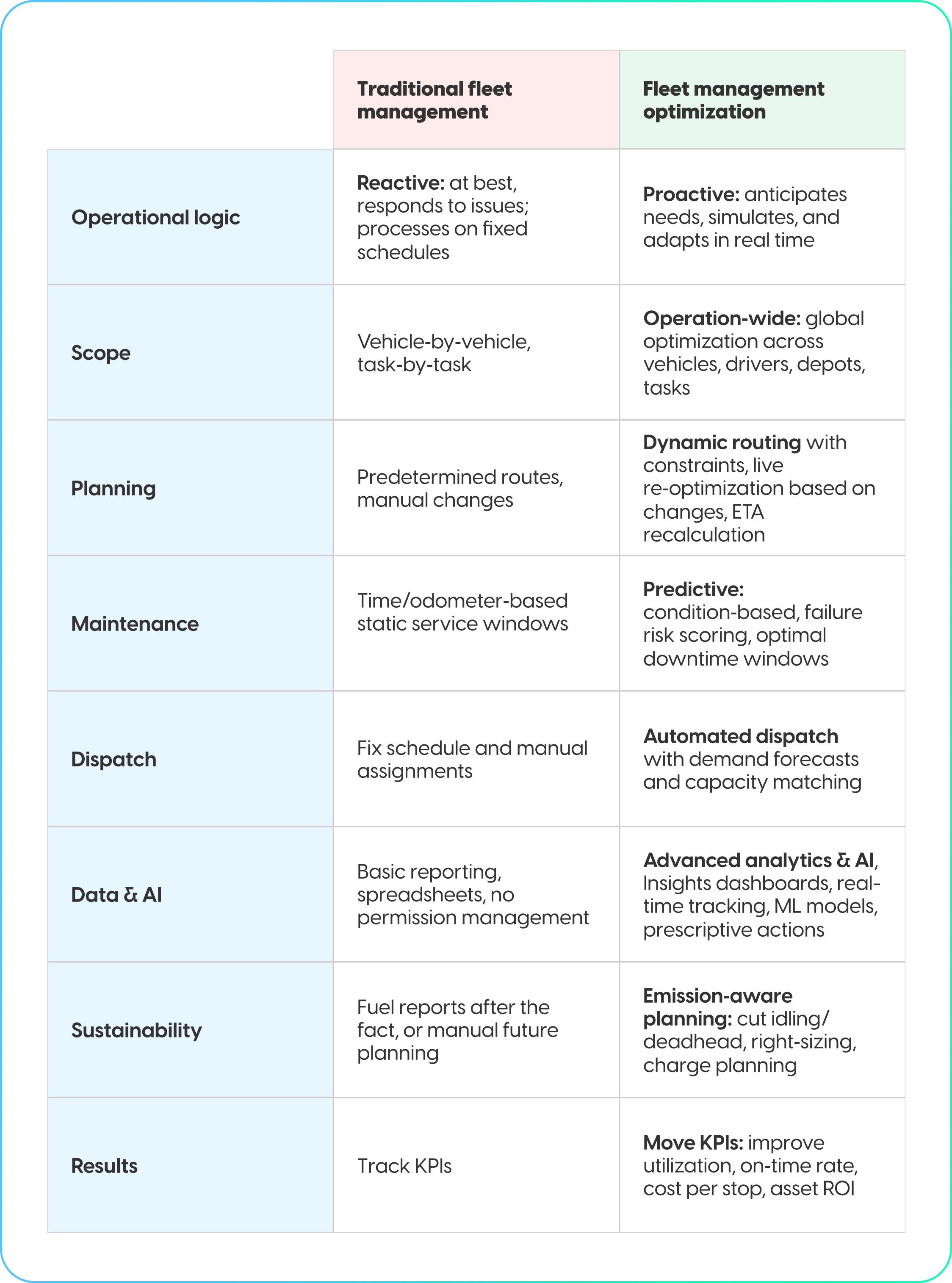
Many management tools have reports with optimization‑sounding labels, such as utilization rates or on-time performance (OTP). But reports describe what has already happened. Modern fleet management software uses an optimization engine to keep performance optimal during operations by deciding o here and now what to do next in order to improve key metrics.
Some of the elements comprising fleet optimization include dynamic planning, scheduling and routing, predictive maintenance, demand‑capacity balancing, shift planning, multi‑stop routing, charging/energy timing, and exception handling. These are all guided by AI and big data processing, machine learning algorithms, and prescriptive automation.
Modern platforms also close the loop with real-time visibility and automation. Instead of reviewing yesterday’s dashboards and manually adjusting plans, an optimization engine ingests live inputs (orders, telematics, traffic, staffing, charger availability) and continuously updates decisions, such as dispatching, routing, rebalancing, and maintenance prioritization to support measurable fleet cost reduction.
Key differences between fleet management and optimized fleet management at a glance
If we are to take carsharing as an example, then the management approach handles each reservation individually as it comes in. These individual bookings may work fine in isolation, but they do not take into account fleet-wide considerations, and as soon as anything happens that causes a change of plans (a vehicle breakdown, a user extending their trip, or a high-demand event in a particular neighborhood, for example), they fail.
An optimization approach starts not with an individual reservation but with the entire demand picture (all current and predicted bookings, user pickup and drop-off locations), all resources (available vehicles across the fleet, their locations, battery or fuel levels, maintenance status), operational constraints (rebalancing needs, charging requirements, parking zone regulations, minimum fleet distribution), and live conditions (traffic, weather, real-time demand patterns, EV state of charge). It runs a solver that determines which vehicles should be where, when they need rebalancing or charging, and how to position the fleet proactively, and importantly, then keep re-solving and reoptimizing as reality changes.
A decision like when a vehicle needs cleaning, for example, becomes an operational one - depending on usage, driver feedback, crews' availability, location, and the fleet’s current needs, rather than a strict schedule. The result: lower costs, less downtime, fewer vehicles needed, higher utilization rates, and higher NPS scores.
Do you need a fleet management optimization platform?
Optimization, in the context of fleet management, extends far beyond the immediate goal of cost reduction. It represents a comprehensive approach to enhancing every facet of an operation, be it increased utilization and capacity, better service quality, or enhanced safety and leaner operations. Using AI to meticulously analyze and refine processes, organizations can unlock hidden efficiencies and maximize their resource utilization.
Flexibility matters. One of the core strengths of an optimized system lies in its high degree of customizability. This flexibility is crucial in today's dynamic operational environments, enabling fleets to swiftly and effectively adjust to a multitude of challenges.
Furthermore, a truly robust fleet management optimization platform can take sustainability and other long-term goals into account naturally, incorporating emission-aware planning into every decision, actively seeking to minimize multiple facets of environmental impact from the get-go.
Embracing a holistic optimization framework, businesses can achieve not only immediate operational gains but also establish a resilient, lean, efficient, and environmentally conscious fleet for the future with:
- Comprehensive fleet‑wide optimization of tasks, assets, people, and time.
- Predictive maintenance that minimizes disruption and downtime.
- Improved asset utilization and rightsized fleet
- Advanced routing capabilities with continuous re‑optimization that make it easy to handle exceptions and unforeseen events automatically.
- Enhanced sustainability and support for long-term goals.
What is required for optimized fleet management
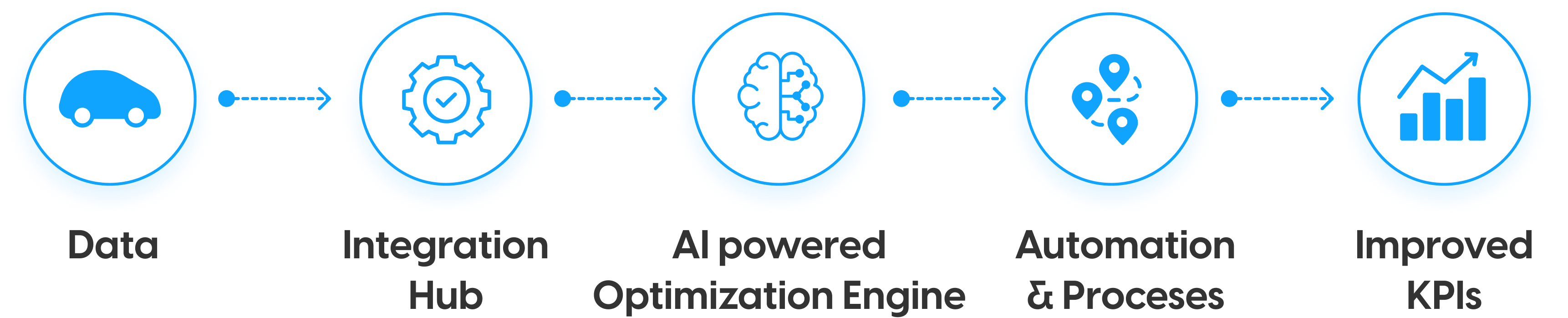
The technologies involved in a fleet management optimization platform include:
- Advanced analytics & AI: for demand forecasting, travel‑time estimation, failure‑risk scoring, driver‑shift optimization etc.
- An Integrations Hub: to connect and mitigate multiple data sources using APIs or webhooks
- An automation engine that allows the system to seamlessly launch actions and execute them (and/or alert a fleet professional).
- Big data processing: for extracting value out of telematics, orders, inventory, maps, charger/energy data, weather, and traffic data fused into a single operational model.
- Machine learning algorithms + solvers: to learn patterns and then compute the best feasible plan under constraints (vehicles, skills, depots, time windows, SLAs, energy, regulations)
The process of advancing from fleet management to optimized operations is not a trivial one. It requires integrating multiple systems and may entail some reorganization. Additionally, many established workflows need to be reviewed and assessed. But the long-term impact of automating and optimizing operations is well worth the effort.
Fleets seeking to improve performance and cut costs can’t afford not to step up to fleet management optimization: a proactive, AI‑driven platform that improves utilization, cuts costs, boosts efficiency, elevates service quality, advances fleet sustainability, and unlocks new growth.
How to Start Moving from Fleet Management to Fleet Optimization
Modernizing fleet management and moving to optimized fleet operations requires a process. Here's how you do it.
- Find where time and money leak: avoidable downtime, long response times, missed preventative maintenance driving up costs, idle vehicles, empty miles, slipping SLAs.
- Focus on the metrics and KPIs that matter to your fleet: utilization, cost per stop, on-time performance, TCO, or anything else that directly affects your performance.
- Ensure a single source of truth, and pull together orders, telematics, maps and traffic, shift availability, maintenance status, and charging for EVs. Start with the sources that feed the decision you're improving.
- Don't trying to fix everything at once. Pick one use case, define what "better" means, then set up automations and optimizations and check on it weekly. Learn from that experience and expand to other use cases.
- Add software that fits what you already run instead of replacing it. It should connect via APIs and webhooks, respect your real constraints, and act on its own: update dispatch, flag exceptions, and send an alert before the SLA is at risk.



Table of сontents