

This will surprise no one - but one of the major changes when switching over to an EV fleet is the need to charge your vehicles rather than fill them up with petrol. This change in the energy source of your fleet sounds simple enough. But charging takes much longer than fueling up. Adjustments to the way you manage your fleet and the way it operates are required.
As you prepare to launch or operate your electric fleet, it is important to understand those changes and prepare for them. Here, we will cover some of the major differences you need to take into consideration as you electrify your fleet. For fuller coverage, we recommend you download Fleet Electrification - The Practical Guide.
Electricity is much cheaper than gas
Simply put, charging is much cheaper. Kelley Blue Book's May 2026 analysis puts the gap in plain numbers. Covering 1,015 miles in a month, which is the US average, costs about $64.65 in electricity charging at home at the national residential rate of 18.83 cents per kWh (and that price can be driven lower with night time use and commercial pricing), against roughly $163.80 in petrol for a car averaging 30 mpg. That is around 60% less. Those are consumer figures, but the ratio holds at fleet scale and usually improves with a commercial tariff. Even using fast DC chargers, and especially using cheaper options like AC charging, powering an EV vehicle costs less.
However, it is not a simple apples-to-apples comparison, and there is no prominent sign to advertise electricity prices like at a gas station. Moreover, there are huge regional differences in the price of both electricity and gas. Households in Rhode Island paid almost twice per kWh what households in Georgia paid in March 2026, 29.91 cents against 15.01 cents. If you're in the US, you can use this tool from Energy Innovation to get a rough estimate of the costs in your region.
However, even in the same area, charge prices can be highly variable. Public DC fast charging typically runs around three times the residential rate, so the same 338 kWh that costs about $64.65 at home runs closer to $169 at a public fast charger priced at 50 cents per kWh. In California, roadside fast charging now runs between 40 and 65 cents per kWh depending on the network and membership, against closer to 35 cents at a depot or at home. That spread is the single biggest reason electric vehicle fleet charging needs to be planned rather than left to whoever happens to be driving.
De-risk EV transition with the right charging strategy
One key for successful EV fleet operations is the formation of the right charging strategy.
Charging takes time. A DC fast charger takes a battery from 10% to 80% in about 18 minutes on a Hyundai Ioniq 5 and about 35 minutes on a Nissan Leaf, with the last stretch to a full battery taking considerably longer as the charge rate tapers. The same 10% to 80% top-up on a Level 2 home charger takes six to ten hours, depending on the vehicle. This affects not only individual vehicles, but the entire infrastructure requirements, as each spot at the station is taken up for much longer, and since charging stations are not widely available enough yet.
There is a growing awareness of this issue, and more and more public charging options are being made available all over the world (backed by considerable government subsidies). Still, waiting times are something to take into consideration, and it is often not enough to know where the nearest station is. You also need to know if there is an open charger you can use.
The right charging strategy takes into account downtime, as well as price and operational concerns. Optimizing charging times, for example, to make sure it coincides with break time, can lead to a minimal impact on your fleet operations.
You can build your own fleet charging infrastructure

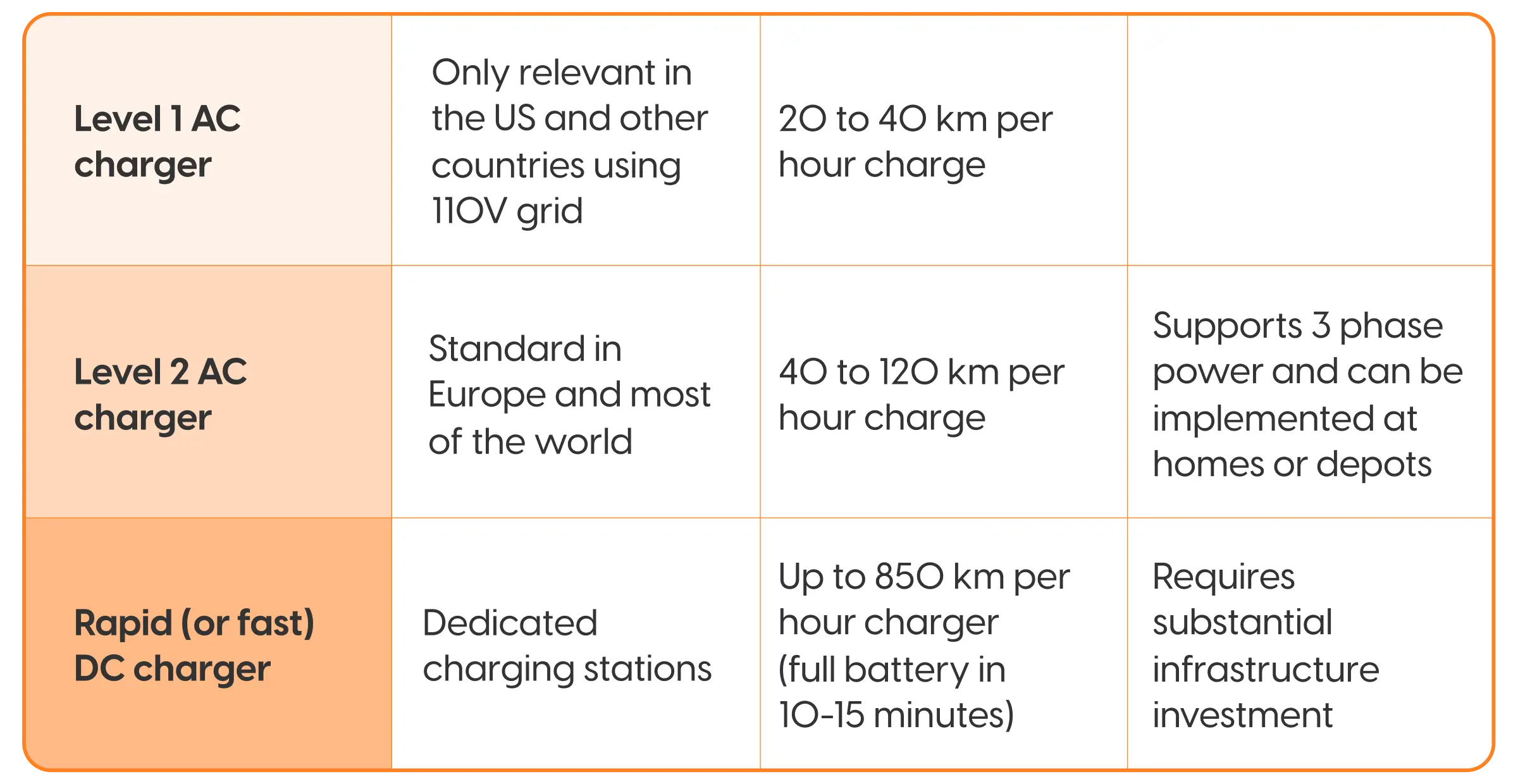
Unlike building your own gas station, building all or some of the infrastructure you need for an electric fleet is something most should consider. For a relatively small investment, you can build your own charging infrastructure. You can even provide charging outlets at drivers' homes, reimbursing them for electricity consumption. A Level 2 home setup runs $2,000 or more per installation, which is modest against the energy savings it unlocks, and as much as 90% of EV charging already happens overnight at home.
These are based on a so-called Level 2 AC charger, using 220V current that is standard in Europe and most of the world, and available in the US. Depending on whether the charger is single-phase or three-phase, they provide roughly 30 to 120 km of range per hour. Leaving vehicles to charge overnight may be enough for some fleets to cover all their routes throughout the day. Adding a top-up at public stations as necessary can save a lot of the fleet's cost.
Building your own DC fast chargers is more complicated and much more expensive. It is not feasible for most, but it may make sense in some scenarios.
In building your own charging infrastructure strategy, you should also take into account that the price of electricity also depends on the time of day. Time-of-use rate plans vary based on the time of day and season, but typically include two or three different rates, and you can expect to pay less during off-peak hours at night and in the early morning. On some charging networks, peak-period rates run close to double the off-peak rate, which makes the scheduling decision worth as much as the tariff negotiation.
There is a second cost that catches fleets out. Utilities bill for peak demand as well as total energy, so ten vans plugging in at the same moment when the shift ends can push a site into a much higher demand charge for the whole month, even though the energy itself is cheap. This is why fleet charging infrastructure planning has to cover the schedule and not only the hardware. Staggering start times across the overnight window, capping how many chargers draw at full power at once, and sizing conduit for the fleet you expect in five years rather than the one you have today are what keep the bill predictable.
Preparing Your Drivers for the Shift to EV Charging
Hardware and tariffs are the parts of EV fleet management that are planned carefully. Driver behaviour is usually the part that gets assumed, and it is where most charging strategies quietly fall apart. A depot can have enough chargers and the right off-peak rate and still start the morning with half the fleet at 40%, because nobody was clearly responsible for plugging in. A few rules fix most of it.
Name an owner for every plug-in. Decide whether the responsibility sits with the driver who ends the shift, the depot team, or a named shift supervisor, and write it down per site rather than per vehicle. Ambiguity between two people is worse than assigning it to the less convenient one.
Set two minimum state-of-charge rules, one for departure and one for handover. A vehicle needs to leave with enough range for its route. It can be even more important to set a handover minimum charge level, so that whomever gets the vehicle has options. Somewhere in the 20% to 30% range works for most urban duty cycles, and it also protects battery health over the life of the vehicle.
Give drivers the charging task, not the charging decision. Asking a driver to judge whether to top up mid-route means asking them to weigh route demand, tariff windows, and charger availability in a car park. Dispatch charging the way you dispatch any other job, with a location, a window, and a target state of charge.
If possible, it can be a good idea to make home charging reimbursement automatic. If a driver has to file a claim to be paid back for electricity, some of them will skip charging instead. Meter-based or per-kWh reimbursement paid without a manual step removes the reason not to plug in.
Review compliance weekly and treat it as a KPI. Track the percentage of vehicles that returned above the floor, plugged in within the target window, and started the shift at target. Patterns show up fast, and they are almost always concentrated in one site or one shift rather than spread across the fleet.
EV fleet in action: plan, simulate, implement
Much like everything else in an electrified fleet, it pays to plan and set up charging policies for your drivers ahead of time. Using advanced simulations can help you prepare for the transition, test out different scenarios, and work out how to react when demand, energy prices, or charger availability shift.
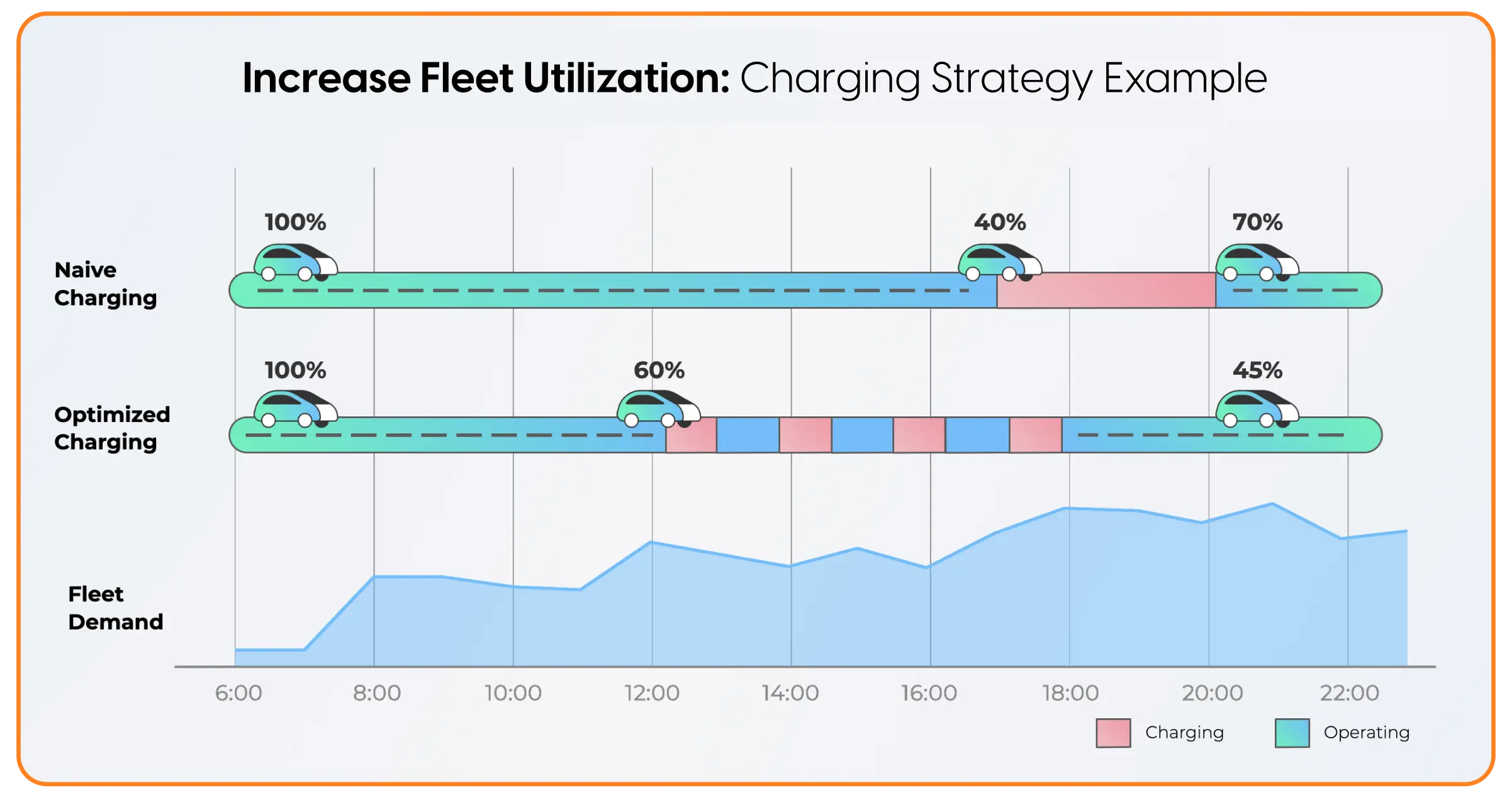
A naïve charging strategy, one that behaves like a traditional ICE vehicle by waiting for the battery to run low before charging it up, can result in longer downtime for charging, maybe when you need it most, at a relatively high energy rate, and an unused full battery at the end of the shift when it is no longer needed.
Different charging strategies. Optimized charging makes sure the vehicle is available at peak demand
Equipping drivers with a charging strategy that considers future demand allows them to complete the day with minimal downtime or deadhead miles, and can greatly improve any fleet's performance.
To learn more about how Autofleet can help you electrify your fleet, set a meeting, or download "Fleet Electrification: The Practical Guide".


Table of сontents