
Managing a large fleet without complete visibility is like navigating a cargo ship through a narrow strait in thick fog. If your data lives in silos (telematics here, maintenance logs there, fuel cards somewhere else, EV charging records in yet another system), and you throw in safety platforms, leasing contracts, compliance tracking, and vendor portals, you have a recipe for missed opportunities and budget leakage.
Gathering data is only the start. What protects your bottom line is turning that data into action. Here are three tips for making sure your fleet data is both visible and usable:

Establish your System of Record (SOR) canonical data
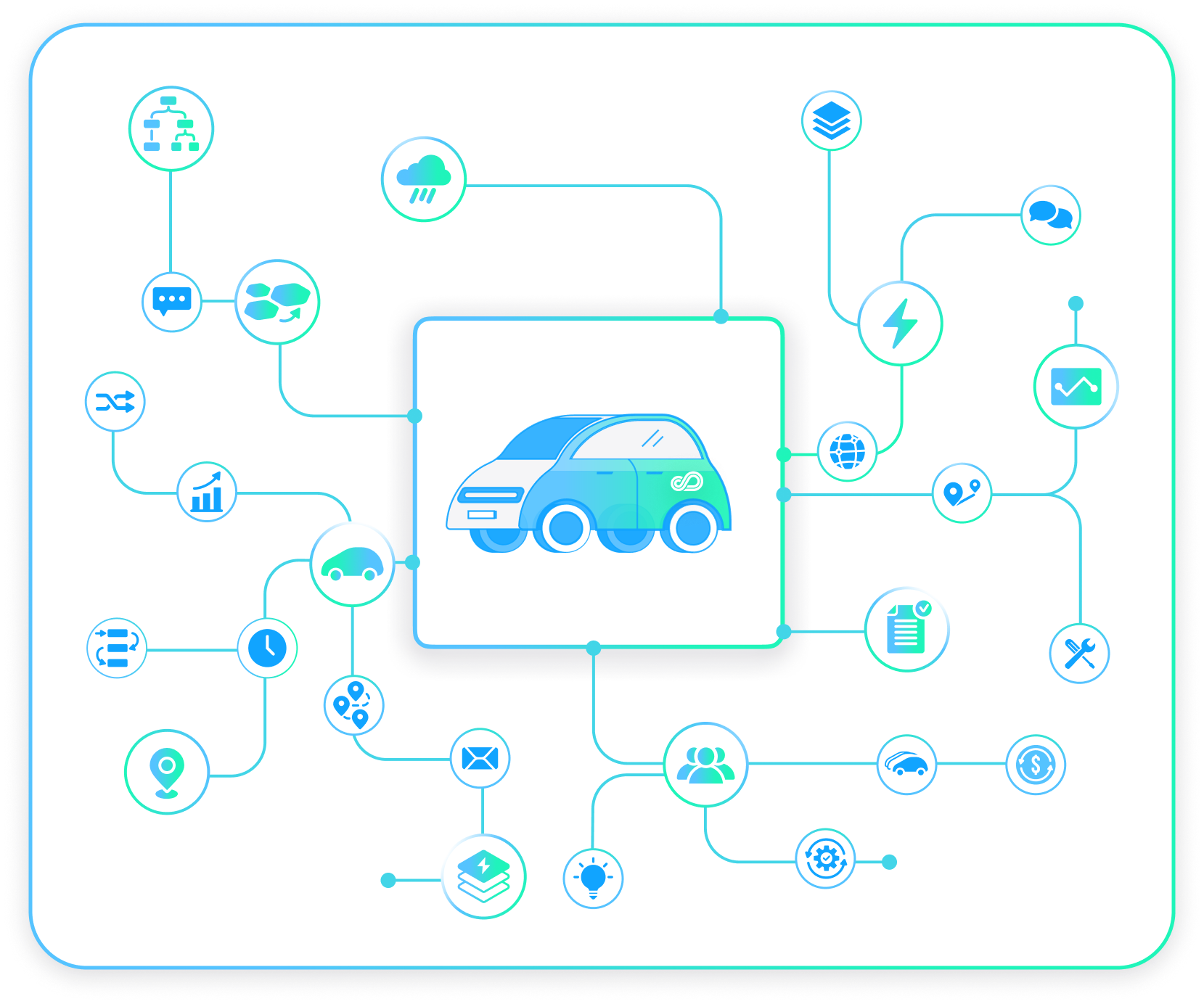
Integrate every system (telematics, maintenance records, fuel and charging data, safety scores, leasing agreements, vendor SLAs, and your existing CRM or ERP) into one unified platform.
This isn’t as simple as just hooking up the systems, and requires normalization, standardization, harmonization, and synchronization of data. But it is well worth the effort.
A unified data source delivers immediate benefits:
- Real-time oversight of vehicle location, status, utilization, and spending
- Cross-validation that catches anomalies before they become costly problems (odometer readings verify maintenance schedules, location data flags suspicious fuel charges, utilization patterns validate lease agreements)
- Credible analytics built on clean, consistent data rather than guesswork
Just make sure you control data access and ensure an auditable process. Enforce SSO with Role-Based Access Control (RBAC), least-privilege permissions, and change logs for every policy and workflow touch. Provide function-specific views for operations, finance/procurement, safety, IT, and executive stakeholders. Customizable dashboards and fields keep the "single pane of glass" relevant to each role without forking systems.

Turn insights into automated action and cost-cutting workflows
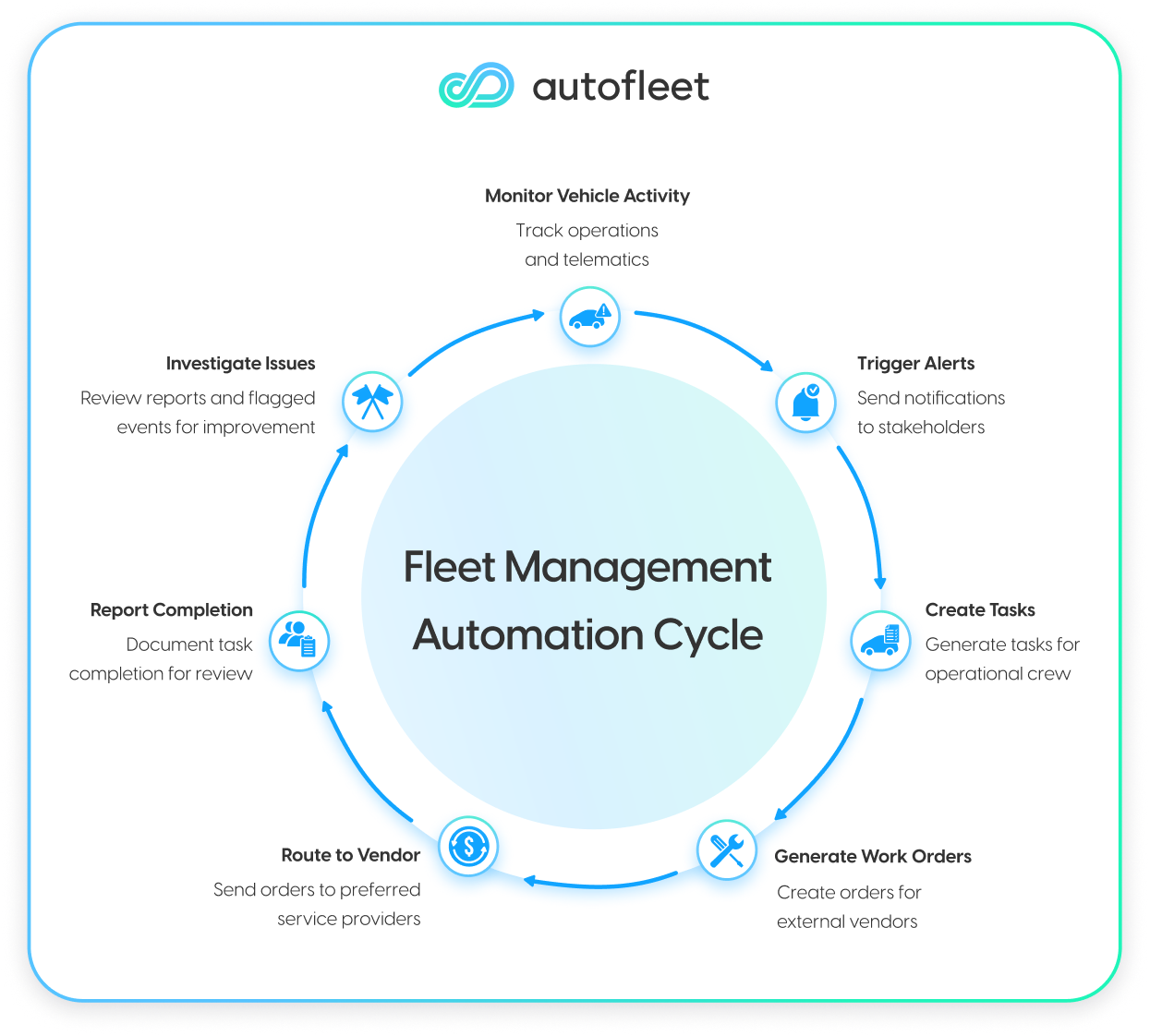
Data without action is valuable - but it is also expensive record-keeping. Modern fleet management means encoding your policies as streamlined automated workflows: when X happens, do Y, then measure Z.
For example:
- Idling management: A vehicle idles for five minutes outside a designated zone? Send an alert. Fifteen minutes? Create a coaching task automatically. Then make sure the automation follows through with reporting when the coaching task is complete.
- Predictive maintenance: Odometer hits the service interval or a fault code appears? Generate a work order, route it to your preferred vendor, and auto-approve if under your threshold.
- Vendor accountability: Your cleaning crew reported they finished cleaning a car, but the next driver flags it as dirty. Reassign the work and flag the event for your team to investigate.
Automated, streamlined workflows make measurable changes: reduced fuel consumption, better adherence to maintenance policies, and faster decisions that directly affect the Total Cost of Ownership (TCO).
Track your automation performance with KPIs and scheduled reviews to ensure policies stay aligned with business goals and do not drift over time.

Continuously optimize operations
Visibility and automation reach their full potential when paired with dynamic optimization. Static fleet planning belongs in the past, and modern fleets continuously optimize to stay effective and efficient.
This includes forecasting demand and re-optimizing routes and task assignments as conditions change. Dynamically allocating vehicles across business lines, even rightsizing fleet mix (ICE/EV/classes) by territory and season to meet peaks with short-term rentals to supplement your regular fleet when needed.
Use simulations to run what-if scenarios before making changes. Test new approaches with A/B experiments. Measure impact on both TCO and service levels, then incorporate learnings into your weekly planning cycle.
Lastly, your platform should grow with you through configurable entities, open APIs, modular architecture, and no-code automation builders. Evolution shouldn't require re-platforming.
Who owns fleet governance: roles and decision rights
The three tips above are critical for good fleet governance. But none of it holds without naming who decides. Function-specific views tell each team what it can see. Decision rights tell the organization who is allowed to change what is seen.
Four decisions need to be made before a fleet data management program goes live.
Data standards come first. Someone has to rule on what counts as a vehicle in service, which odometer reading wins when telematics and the maintenance system disagree, and how a cost center maps to an asset. This belongs with fleet operations and management teams more often than with IT, because the definitions describe the operation rather than the database. IT owns how the standard is enforced in the pipeline.
Automation rules and policy changes come next. Every trigger you encode is a policy with a budget attached. An idling threshold, an auto-approval limit on work orders, a reassignment rule when a cleaning job is disputed: these need to be considered before an automation is put in place, and with a clear escalation path for when an automated response is not enough.
Access levels need a signatory. Role-based access control only means something if someone enforces a clear policy, and the roster needs to be reviewed on a fixed cadence rather than when somebody leaves.
Exceptions need a path to resolution. Decide in advance who resolves a conflict between two systems, and who can override an automation mid-shift without waiting for a committee.
Keep an audit trail with records of all four in one versioned place, each entry carrying a date and an approver. A short decision log next to your data definitions is worth more than a policy document nobody opens, and it is what makes fleet compliance provable: when an auditor asks why a threshold changed in March, the answer is a line item rather than a search through Slack. Governance specialists writing on 2026 priorities make the same point outside the fleet, that responsibility spread across IT, risk, and the business tends to produce unclear decision rights and weak escalation paths unless the authority is written down.
Visibility is valuable, but it can drive much more
Fleet visibility isn’t the finish line; it’s the flywheel. Once you have visibility, it can power multiple processes, workflows, and managerial decisions. Smart managers operationalize what they see: policies become triggers, triggers launch automations. Optimizations prove impact on cost, uptime, safety, and sustainability across ICE and EV fleet management.


Table of сontents