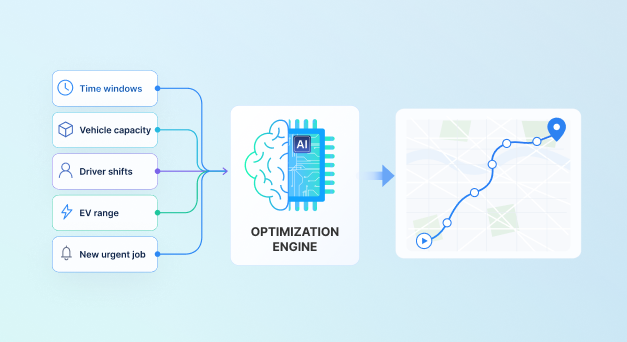

Passenger transport is shaped by people, which makes demand naturally dynamic. This creates some unpredictability during the course of a day, as people change pick-up points, cancel, run late, or request a ride at short notice.
Ride-hailing has also changed what passengers expect from transport services. It’s now considered standard to get instant confirmation of a vehicle on its way, often with an arrival time of minutes.
For paratransit, microtransit, corporate shuttles, and mixed on-demand services, this turns routing into a continuous challenge. Operators must assign the right vehicle to each ride without undermining the commitments already made to other passengers.
What real-time route optimization means for passenger fleets
Real-time route optimization is the continuous recalculation of vehicle assignments, stop sequences and routes using the fleet's current operating conditions. This differs from static route planning, which builds an initial plan from pre-booked rides with ride-hailing drivers matched to passengers when the request arrives. Drivers then use live navigation to find their way around congestion while operators monitor the situation.
True, real-time optimization takes this a step further. It looks at current information over the entire fleet, not just an individual vehicle or route, and asks whether the plan needs to change. This may mean inserting a pickup, resequencing stops, pooling compatible rides, or repositioning an available vehicle.
Dynamic route planning should not create additional disruption, however. Sometimes the best decision is to retain the current route because the potential improvement doesn't justify changing instructions or ETAs.
The variables that make static routing fail for passenger transport
Ride-hailing and passenger operations combine unpredictable demand with strict service commitments. The initial plan can quickly lose accuracy when the fleet encounters:
- New requests, cancellations, no-shows, or will-call returns
- Congestion, road closures, incidents, and longer pickups
- Late drivers, shift changes, breakdowns, or charging needs
- Capacity, accessibility, certification, and service-zone requirements
- Pickup windows, maximum ride times, and contractual SLAs
The effect is rarely limited to one ride. A ten-minute delay now may make a driver unsuitable for a later pre-booked pickup. Adjusting that driver’s navigation can move the problem rather than solve it.
How adaptive routing engines process live data to reroute vehicles
Consider a shuttle fleet with several pre-booked trips. One vehicle is delayed, and an ASAP request also arrives. It might be that the nearest driver could reach the new passenger quickly, but in doing so, would put later pick-ups at risk.
An adaptive routing engine handles these decisions in a continuous loop:
- Update the fleet state: The engine combines bookings, GPS locations and heading, traffic, vehicle and driver availability, ride progress, and future commitments.
- Generate feasible options: It tests inserting the ride, assigning another vehicle, swapping future bookings, pooling rides, or retaining the current plan.
- Apply operational constraints: Options that breach capacity, accessibility, driver eligibility, shift, service zone, pickup window, or maximum ride time rules are removed.
- Score the remaining plans: The engine compares passenger wait time, on-time performance, deadhead mileage, cost per ride, utilization, and disruption to existing routes.
- Dispatch the decision: Updated assignments, navigation, and ETAs reach drivers, dispatchers, and passengers. Execution data then feeds into the next calculation.
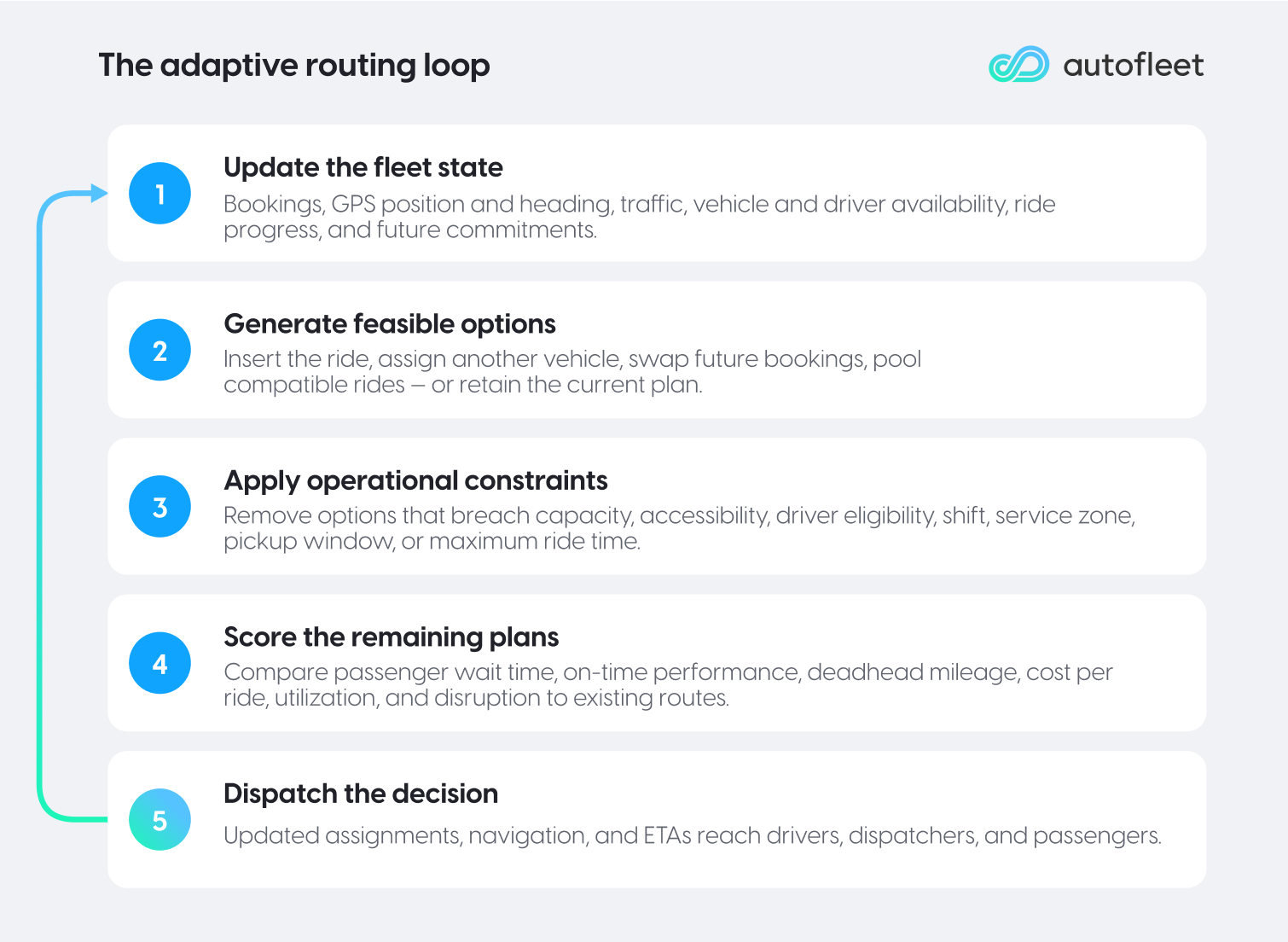
This is the difference between reacting to incidents and optimizing their effect on the entire operation – often automatically. This reduces manual replanning and allows dispatchers to manage exceptions before delays cascade through the rest of the operation.
What changes for drivers, dispatchers, and passengers when routes adapt live
For drivers, the current stop sequence and new assignments arrive through a consistent workflow instead of calls and manually amended manifests. Clear instructions remain essential, particularly when routes change mid-shift.
For dispatchers, the job shifts from repeatedly rebuilding routes to managing exceptions. They can see which rides are at risk, understand the recommended response, and intervene when local knowledge or a sensitive passenger situation requires human judgment.
For passengers, live adaptation supports more reliable pickups and ETAs. When plans change, updated tracking and proactive notifications provide certainty instead of leaving passengers wondering whether their ride is still coming.
The effect of real-time optimization should be visible in operational and passenger-service KPIs. Operators should compare performance before and after implementation, but also examine how results change by service area, time of day, ride type, and passenger requirement.
Useful metrics include:
- On-time pickup and drop-off performance: The percentage of rides completed within the promised service window.
- Passenger wait time: Both the average and the longest or 90th-percentile wait times. An acceptable average can conceal a smaller number of seriously delayed passengers.
- ETA accuracy: The difference between the ETA provided to the passenger and the vehicle’s actual arrival time.
- Ride completion rate: The proportion of requested or accepted rides successfully completed.
- Vehicle and driver utilization: How much available capacity is used for passenger service rather than waiting or traveling empty.
- Deadhead mileage: The distance vehicles travel without passengers.
- Manual dispatch interventions: How often dispatchers must rebuild routes, reassign rides, or contact drivers outside the normal workflow.
No single metric proves success. Reducing miles while increasing passenger wait times would be a poor trade-off. The aim is to improve fleet efficiency while maintaining or improving service reliability.
Keep the plan connected to reality
Static planning gives a passenger fleet its starting point. Real-time optimization keeps the operation aligned with demand, vehicle availability, and service commitments after the day begins. By connecting visibility, fleet-wide optimization, and automated dispatch, fleet optimization software can help operators complete more rides with existing resources — without making reliability the trade-off.
See how Autofleet combines dynamic route optimization and dispatch for planned, on-demand, and mixed passenger services.



Table of сontents
V4new%252026.11.jpeg)