
One of the many questions surrounding the proliferation of autonomous vehicles is its effect on curb usage. Curbs are a critical element of urban mobility, serving as a shared resource for delivery vehicles, public transport, and ride-hailing services. Introducing restrictive policies for shared AVs (also known as robotaxis) could add more than 200,000 km (124,000 miles) to a fleet's daily travel. Leading to an unintentional increase in congestion and operational costs by forcing empty vehicles to circulate.
This is a headline finding from a new study examining how curb restrictions could affect shared autonomous fleets in San Francisco.
Researchers from Ajou University, UC Irvine, and UC Berkeley found that preventing vehicles from waiting at the curb between trips increased daily vehicle kilometers traveled by nearly 60% compared with scenarios that allowed curb staging.
This analysis was carried out based on data provided by Waymo and expanded to reflect future demand, and using Autofleet’s Fleet Planning Simulator. Researchers used the platform to model how a large robotaxi fleet would respond to different curb policies and operating strategies.
The study also shows that urban mobility policy cannot be evaluated in isolation. Legislation may reduce one type of curb activity, but could also create congestion due to more empty vehicles on the road. For fleets, this also increases energy use and operating costs.
What is curb staging?
Curb staging allows an autonomous vehicle to temporarily wait at the curbside after completing a trip and before being assigned another trip. Without this, the empty vehicle still has to go somewhere.
Depending on the rules set by the autonomous vehicle fleet operations team, this might mean the vehicle circulates, travels to a designated parking area, or is repositioned to another part of the service area. Each of these affects road use, fleet efficiency, and the amount of empty travel generated by the operation.
Empty mileage (or deadhead miles) is one of ride-hailing’s central efficiency challenges. Previous research has estimated that 40% of ride-hailing vehicle miles are traveled without a fare-paying passenger.
While curb staging may make a lot of sense for robotaxi fleets, these aren’t the only vehicles using the road. Deliveries, public transport, accessible parking, and micromobility may all need to use that curb space. On top of this, emergency services need to be considered, as well as the volume of traffic on the road.
The question around whether autonomous vehicles should be allowed to wait is a valid one. However, cities need to understand what happens across the transport network when curb staging is restricted.
Using simulation to test decisions before deployment
Autofleet’s Fleet Planning Simulator creates a controlled environment for autonomous vehicle fleet management strategies. Teams can configure demand, territory, fleet size, vehicle characteristics, parking and charging infrastructure, and operating policies, then measure the effect across operational and financial KPIs.
Different configurations can be tested against the same baseline, making it possible to understand the relative impact of each change before applying it to a live operation. Autofleet’s simulator can account for real traffic conditions and compare configurations – such as fleet size, parking locations, charging infrastructure, locations, restrictions, and driver shifts.
This independent academic use of Autofleet’s simulation technology demonstrates its ability to model complex fleet behavior at city scale. This ensures that policy, demand, infrastructure, and operational strategy can all be considered.
Modeling a 1,700-vehicle fleet in San Francisco
The paper, Staging at the Curb: Evaluating the Impacts of Shared Automated Vehicle Fleet Operations Under Curb Usage Restrictions, establishes a baseline scenario in which 1,700 shared automated vehicles serve 68,000 daily trips across San Francisco. The researchers combined ride-hailing demand with high-resolution forecasts of curb availability in the city.
Using Autofleet’s Fleet Planning Simulator, the researchers took this baseline and then varied whether vehicles could stage, where and when staging was permitted, and whether vehicles were strategically repositioned toward demand. This also took into account variations in demand across each day of the week.
To assess the performance, the researchers measured:
- Total vehicle kilometers traveled
- Curb productivity
- Customer wait time
- Customer matching rate
Using Autofleet allowed the research team to examine curb policy as an operational system. Instead of stopping at the question of where vehicles could wait, the model showed what 1,700 vehicles would do when that option was restricted.
A full ban pushed vehicle travel up by 60%
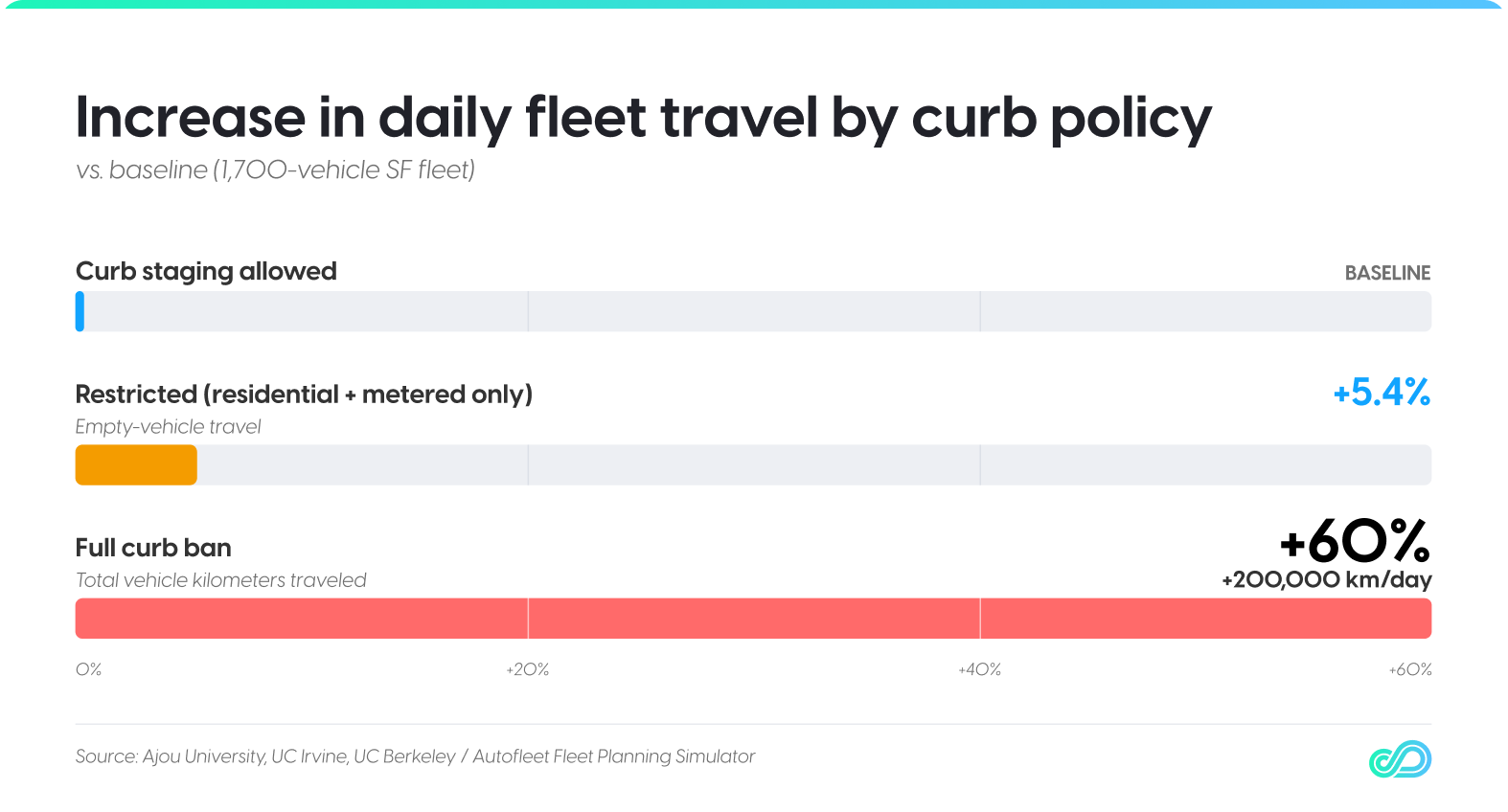
The most dramatic result came from the scenario where robotaxis were excluded from staging at the curb. This restriction added more than 200,000 km to daily fleet travel.
Preventing a vehicle from staging doesn’t remove it from the transportation network. Instead, that vehicle is forced to travel somewhere else or keep moving until it receives another assignment. Across 1,700 vehicles, this compounds quickly.
Empty travel increases traffic, accelerates vehicle wear, and drives up operating costs. For autonomous vehicle fleets, this could also create additional charging demand without improving service capacity.
Targeted restrictions have a different impact
This impact does not mean cities should give autonomous fleets unrestricted curb access. The researchers also used the Fleet Planning Simulator to test more limited policies. These only prohibited curb staging in residential areas and at metered parking spaces. This avoided the larger increase that a blanket ban would have caused, but still raised empty-vehicle travel by 5.4%.
For a robotaxi fleet to continue serving residents, restrictions should be judged against more than curb occupation alone. Empty mileage, road traffic, customer wait times, matching performance, and the needs of other curb users all belong in the same policy conversation.
The solution could be a more flexible approach. For example, a commercial street during peak hours may require different controls from a residential area overnight. Maximum dwell times, designated staging locations, time-based restrictions, or dynamic access policies could strike a better balance than a single universal rule.
The study does not conclude that shared automated vehicles should have unlimited curb access. It shows that every restriction produces an operational response, and that response needs to be understood.
For cities preparing for larger autonomous fleets, simulation provides a way to explore these trade-offs before policies are finalized. For operators, it makes the effects of staging and repositioning visible before they become daily operating costs.
See how Autofleet can help you test your next fleet scenario. Book a demo with our team.


Table of сontents