
Fleet and mobility operations are where strategy becomes reality. They are where efficiency is won or lost, where customer experience is shaped, and where growth either holds or breaks.
One prime example of this is the 2026 Fleet Optimization Pioneers Optimizers Award winner: Dollaride. Dollaride is a Brooklyn-based clean transportation platform founded by Su Sanni. It is building an electric-vehicle-as-a-service model that helps small transportation operators electrify their fleets, optimize their routing, and modernize operations that have often been left behind by the broader mobility technology ecosystem.
We spoke with Su about the origins of Dollaride, the operational realities of electrifying small fleets, and why optimization starts with understanding the people doing the work.
First, can you introduce yourself and Dollaride?
I’m Su Sanni, CEO and founder of Dollaride. We’re based in Brooklyn, New York, and we are a clean transportation platform for small fleets.
We help operators electrify, optimize routing and service, and move from gas-powered vehicles to electric vehicles through a turnkey solution. Our customers are typically paratransit, non-emergency medical transportation (NEMT), and commuter van operators.
You won the Pioneer Award. What makes Dollaride’s model different?
Our unique contribution is that we lead public-private partnerships with local governments. Those partnerships help subsidize the cost of electric vehicles and charging infrastructure.
As a result, when our customers lease from us, it is often the lowest-cost option they can find because a meaningful portion of the cost can be subsidized. That matters because many of these businesses are small operators. They do not always have the capital to buy brand-new EV vans or minibusses upfront.
Why did you start Dollaride?
I founded Dollaride because I personally lived in transit deserts in New York City. These are areas, even in places like Brooklyn and Queens, with limited access to public transportation.
I had to rely on dollar vans and dollar cabs just to reach the nearest subway before starting a long commute. That experience gave me a deeper understanding of how important transportation access is, and how many small businesses and micro-entrepreneurs are already part of the transportation ecosystem.
I wanted to build Dollaride as a technology platform and resource for the little guys: the mom-and-pop transportation companies that people rely on every day.
What was the biggest optimization challenge early on?
At first, the biggest challenge was introducing software-based technology to small business owners who were used to managing things with pen and paper.
We helped overcome that by bringing a lot of routing and optimization work in-house and making it easier for customers to manage. In a sense, we are trying to become their back office.
More recently, the challenge has shifted to financing. We own vehicles and charging infrastructure, but we purchase them using a mix of debt, grants, public agency support, and tax equity. That capital stack is complex, and scaling fast enough to meet demand is one of our biggest operational pressures.
Why is EV adoption such a difficult operational transition for small fleets?
The first challenge is cost. Electric vehicles are expensive upfront, and most small business owners do not have a lot of cash sitting around to buy new vehicles.
The second challenge is operations. Larger EVs do not always have the same range as gas-powered vehicles, so even when the economics are attractive, the operator still has to change how the business runs. They need to think about overnight charging, daytime charging, route planning, vehicle swaps, and on-time performance.
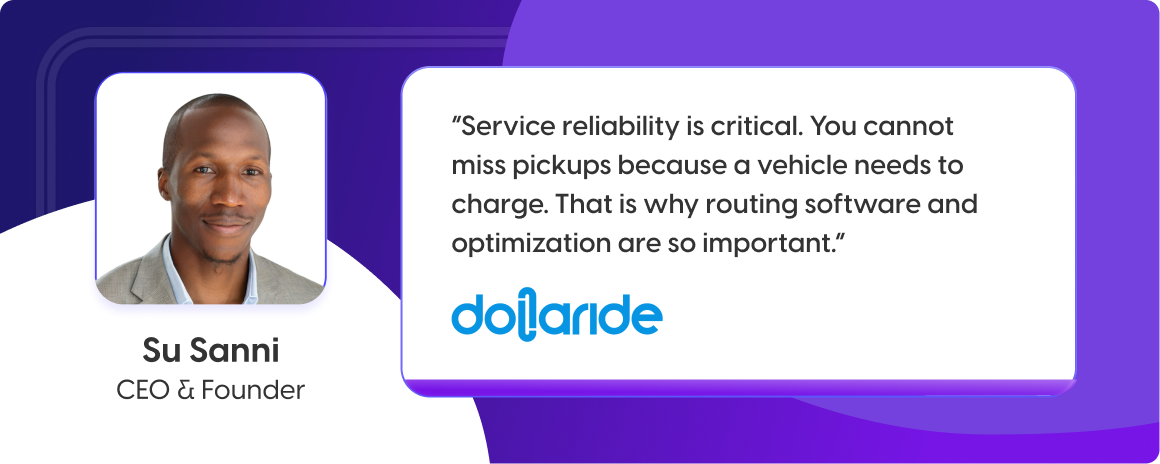
For many of our customers, especially those with government contracts, service reliability is critical. They cannot miss pickups because a vehicle needs to charge. That is why routing software and optimization are so important.
Can you share a customer story that shows the impact?
One example is Green Trips, a non-emergency medical transportation company in New York. The founder had wanted an electric fleet for years, but the cost, range limitations, and operational changes made it difficult.
We helped them get their first electric vehicle. The first few weeks were hard. They had to rethink routing, train drivers, and adjust daily checks. But then the impact started to show. Drivers liked the vehicles because they were smoother and easier to work with, and the company started seeing savings because it was spending less on gas.
Within about four months, Green Trips went from testing one EV to buying 10 vehicles from us. They have a fleet of 30 now and want to replace all of their gas-powered vehicles with EVs, then eventually grow to 50 vehicles.
That is the kind of story we want to repeat with every customer.
What KPIs guide your decisions?
When we work with a customer, we focus on cost per mile, total cost of ownership, charging infrastructure utilization, and operational performance. Those are the numbers that show whether the EV transition is actually working.
What advice would you give another company trying to replicate your model?
Start with the dollars and cents first.
The environmental benefits matter, and cleaner air matters, but the first question for the customer is always: Will this help me save money or make money? Once you can answer that, the conversation opens up to everything else.
What is next for Dollaride?
The big goal is to electrify 1,000 vehicles. That is ambitious, but the demand is there. We already see strong opportunities across NEMT, paratransit, senior transportation, and especially commuter vans.
Commuter vans are a major untapped opportunity. They are like hundreds of informal shuttles moving through the city, often operated by individual owner-operators. If those vehicles can become electric, efficient, and better routed, the economics can be very strong.
Where do you think mobility is heading over the next three to five years?
The government will continue outsourcing ground transportation to small business owners because it can be more cost-efficient. That trend is not going away.
At the same time, transportation is moving toward zero-emission vehicles and eventually more autonomous vehicles. Companies that can provide routing, infrastructure, and services for electric and autonomous fleets will be well-positioned.
As the winner of the Optimizers Pioneer Award, what is one lesson you would pass on to future mobility entrepreneurs?
Embed yourself in your customers’ operations.
Once you understand how they actually work, you can figure out what solutions make sense, what will be attractive to them, and what will help the business grow.
That is also why Dollaride stood out as a Fleet Optimization Pioneer. The company is not just bringing EVs into small-fleet operations. It is building the financial, operational, and technological layer that makes the transition practical.
For operators who have historically been asked to modernize without the capital, infrastructure, or tools to do it, Dollaride offers a different path: one where electrification, routing optimization, and business viability move together.
Read more winners' stories here.


Table of сontents