
Fleet and mobility operations teams rarely get the spotlight, but they are where strategy becomes reality. Cost, service quality, utilization, sustainability, and resilience are all shaped by the people making operational decisions every day. The Optimizers Awards were created to recognize those operators, innovators, and teams turning fleet complexity into measurable business impact across the industry.
USPS won the Optimizers Awards 2026 for Best Route Optimization for transforming one of the largest and most complex transportation networks in the world. The award recognized USPS and Peter Routsolias, Chief Logistics Officer for the United States Postal Service, for rebuilding a national middle-mile transportation network from the ground up, delivering $1.7B in savings and a 40% reduction in unplanned trips, validated by the Inspector General.
We spoke with Peter about the logistics network he leads, what makes postal optimization different from almost every other fleet challenge, and how USPS built a more efficient, consolidated, and resilient transportation model without compromising its universal service obligation.
First, congratulations. Can you introduce yourself and your role at USPS?
I’m Peter Routsolias, Chief Logistics Officer for the United States Postal Service.
My team is responsible for the middle mile. That means we do not pick up mail, and we do not deliver it to homes. We handle everything in between: moving mail from origin facilities through the USPS transportation network and getting it to the right delivery units for final delivery.
That includes transportation procurement, execution, and management of roughly 55,000 truckloads a day. USPS also operates a private fleet with about 12,000 USPS-employed drivers, in addition to transportation capacity procured from major carriers.
What makes the USPS network so unique from an optimization perspective?
The defining difference is our universal service obligation. Unlike commercial carriers, delivering to roughly 170 million addresses six days a week is a mandate, not a strategic choice. Private shippers can optimize by delaying low-density routes until a truck is full. We must go every day, regardless of volume. This completely shifts the optimization equation.
Our goal isn't just to build the cheapest network from scratch, but to innovate within a fixed, non-negotiable service framework to make it better, smarter, cheaper, safer, greener.
What challenge triggered the optimization effort?
It started with truck utilization. We had trucks going out every day because they had to go out every day, but many were far from full. So we started asking: how do we maintain daily service while building better loads and better frequency? That led us toward a cross-dock model, similar in concept to a Less-Than-Truckload (LTL) shipping method, where we share the load (and costs) via a hub-and-spoke network.
Instead of having half-full trucks crisscrossing the country, smaller shipments move into larger facilities where they can be consolidated, cross-docked, and sent out in fuller truckloads. The benefits are clear: fewer miles, better utilization, lower cost, lower carbon emissions, less handling, less damage, and mail that still arrives on time and intact.
Which KPIs guided the work?
The big one was capacity utilization or cubilization. How full the trucks are. We also measured the number of trips, total miles, cost per mile, carrier performance, on-time service, accidents, and carbon footprint.
For the optimization work, the guiding KPIs were simple: put more on the trucks, reduce the number of trips, and reduce the number of miles without breaking the service commitment. With these metrics in mind, over the past three years, USPS has taken about $2 billion out of supply chain costs.
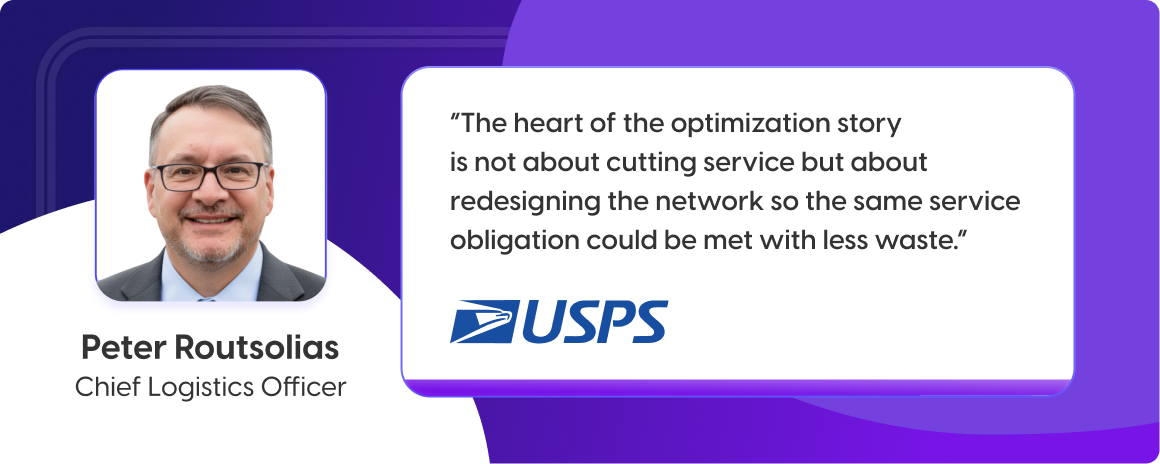
That is the heart of the optimization story. It was not about cutting service. It was about redesigning the network so the same service obligation could be met with less waste.
What role did data and technology play?
USPS had a lot of internal data, but not all of it was connected to the questions we needed to answer. The first step was measurement. You cannot manage what you cannot measure.
We worked with internal data, external benchmarks, and third-party software providers to build the optimization approach. We also brought in outside consultants and tools for tracking, carrier safety performance, contract management, procurement, and network visibility.
The goal was to create a clear understanding of the network: service, cost, safety, carrier performance, and where the opportunities were.
What was the hardest part of implementation?
Without a doubt, it was change management. USPS has a 250-year history filled with people who care deeply about the mission and know the system inside and out after 20, 30, or 40 years of service. But because of that longevity, many hadn't seen how the world's largest retailers and freight companies like Amazon, Walmart, Ashley Furniture,XPO, or Schneider handle modern logistics. A big part of our job was education.
We needed to demonstrate what a modern TMS can do, how to improve procurement, and how to track carrier performance using industry best practices. Historically, success was defined almost exclusively by one metric: did the mail get delivered? While execution remains paramount, we are now challenging our network with broader strategic questions: how can USPS execute better, faster, smarter, cheaper, greener, and safer?
What private-sector best practice did not translate well to postal logistics?
One major difference is that many private shippers can wait until trucks are full or choose not to serve certain expensive lanes. USPS cannot. The lesson is to start with your business rules. Understand the constraints that cannot change, then build the optimized network around them.
Also at USPS, everything takes longer. There are government regulations, procurement rules, bid processes, and the possibility of protests.
So, Peter, what comes next for your team at USPS?
There is still more optimization to do. We are continuing the lean cycle of plan, do, check, act. The next challenge is finding further savings while facing transportation rate pressure, driver shortages, and government regulation.
Mail volume has declined dramatically over the past 15 years, while package volume continues to grow. That means USPS has to stay relevant by adapting its network to a package-first future.
The lesson is simple: embrace change, because change is always needed.
USPS’s The Optimizers 2026 Best Route Optimization win shows what modern fleet optimization looks like at the highest level of complexity. It is not only about finding shorter routes. It is about designing a network that respects real-world constraints, consolidates intelligently, improves utilization, reduces unnecessary movement, and still delivers reliably under pressure.
Read more winners' stories here.


Table of сontents