
When your field service fleet struggles to stay on top of its job schedule, you know you’re in trouble. Over the course of a day, even the smallest changes can affect performance: Traffic causes delays, a malfunction takes a vehicle offline, and urgent tasks disrupt even the most carefully planned schedule. This makes field service routing a multi-objective optimization problem. You’re trying to protect SLAs, reduce travel time, respect technician skills, fit within site hours, avoid overtime, and handle urgent jobs all at once.
Many teams evaluating field service routings software face a challenge mapping the real constraints that create daily chaos. Which jobs must be done by certified technicians, which require a specific vehicle or equipment, which require customers to have site access rules, and which tasks cannot be moved without penalties. The right platform should show how those constraints are represented in the model, not hidden behind generic settings, and route taking all of them into consideration. If dispatch has to override recommendations all day, the optimization is not matching the operation, and performance will not improve after go-live.
When every job is shaped by a set of constantly constraints some shifting and dynamic and others dictated by the nature of the job, fleets need an optimized dynamic routing solution that constantly re-optimizes throughout the day based on all available information.
5 features to look for in an optimized field service routing solution
Modern route optimization software comes with a range of tools and capabilities to help manage job matching, dispatching, and routing. Here are the 5 capabilities you need in order to ensure your field service routing solution gives you the best results.
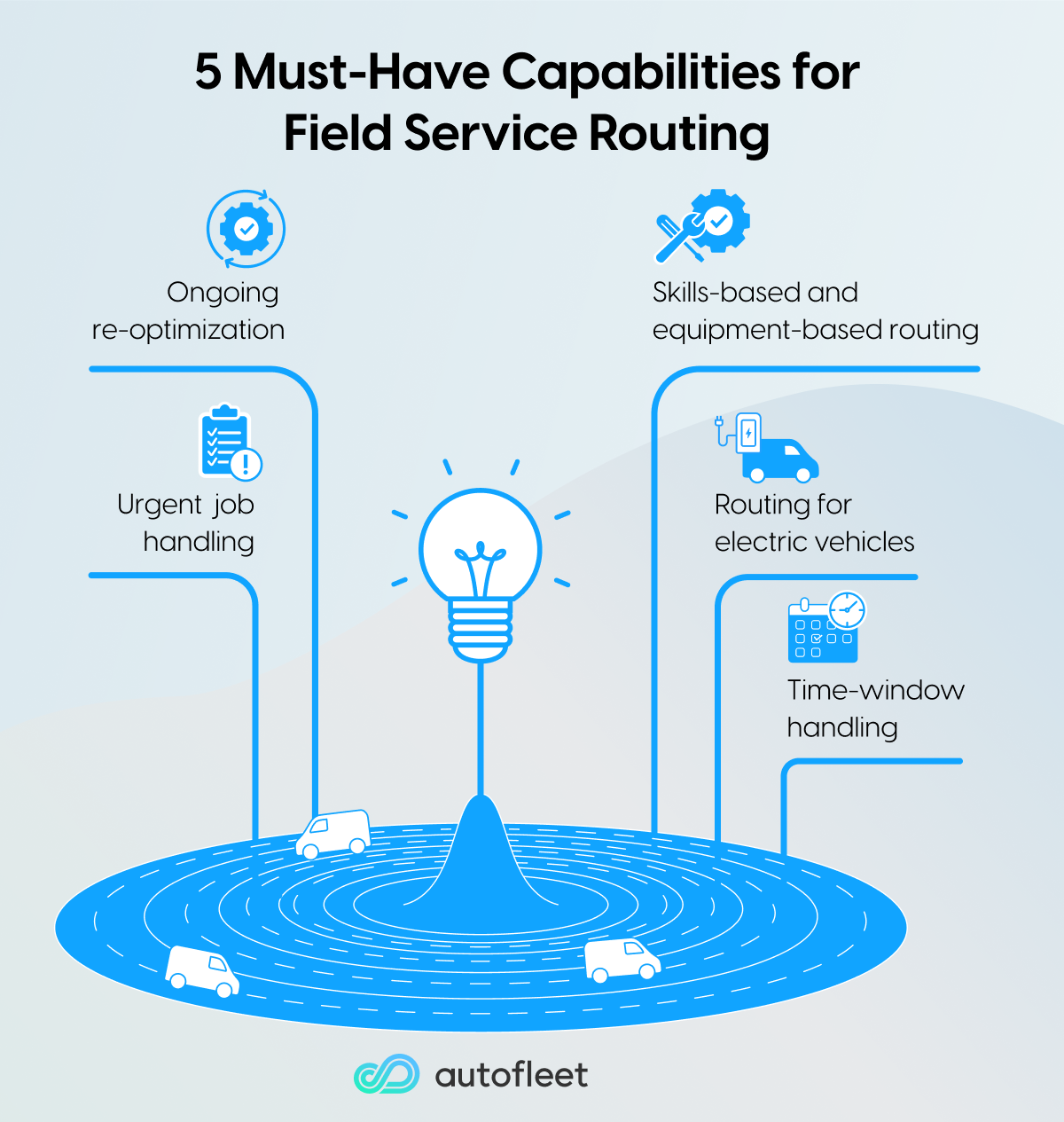
1. Dynamic ongoing route and schedule re-optimization
Things change quickly on the road, jobs get complicated, or take a lot less time than expected. If you are tied to a fixed plan, you are bound to bleed time and money. AI-powered dynamic routing continuously monitors real-time information to ensure the fleet operates as efficiently as possible, while also improving ETA accuracy.
In a demo, ask to see what the system does when reality diverges from plan: a job runs 30 minutes long, a technician marks a part missing, or a customer requests a same-day time change. Strong route optimization for field service should re-sequence the rest of the day without constantly reassigning every job across the whole fleet. Dispatch needs controls, like locking a technician to a customer or freezing a route that is already in progress, then re-optimizing only what is still flexible.
2. Reoptimizing to handle urgent and high-priority jobs
Not all changes stem from conditions in the field. Sometimes you need to change your plans because an unplanned urgent job comes in, or a high-priority VIP client requires special care. When reviewing field service routing tools, consider how the system incorporates new requests into existing plans. The solution must be able to absorb last-minute work, reshuffle assignments, and re-optimize based on new information to minimize disruption.
3. Skills-based and equipment-based routing
Without skills and equipment-based routing, there’s a chance an unqualified technician will be sent to a job, or one could get there without the necessary tools. When dispatchers are reacting manually to changes in high-pressure situations, this mistake can easily be made. If the system understands technician certifications, equipment requirements, and job complexity, however, it can assign work based on capability rather than proximity. This reduces rework and increases first-time fix rates.
This capability should also work in the opposite direction: if the system cannot find a qualified technician inside the time window, it should surface the tradeoff clearly. For example, “meet the window but send an unqualified tech” should never be an option. Instead, it should propose alternatives like shifting a non-urgent job, escalating for overtime approval, or offering the customer a new slot. This is where routing and scheduling either protects quality or quietly creates repeat visits.
4. Routing field services for EV and mixed fleets
Electric Vehicle (EV) routes need to be optimized differently from traditional Internal Combustion Engine (ICE) car routes. A dynamic routing system can handle both vehicle types and anticipate when an electric vehicle will need to charge and make plans based on current range, charger availability, charging time, and the overall impact on utilization. This keeps the fleet moving during busy periods and prevents avoidable downtime.
Leading platforms also account for charger compatibility and charging policy, for example preferred networks, minimum state-of-charge on return, and whether charging can happen during breaks or must be scheduled as a dedicated stop, so EV routing does not collapse under real utilization pressure.
5. Time-window handling
To ensure customer satisfaction, you should treat your service windows as fixed constraints that should not be moved. When a routing engine sees the time windows you committed to in your SLAs as a hard constraint, it optimizes routes to ensure you stay within them. This can also allow you to commit to tighter arrival windows without increasing operational risk, as the algorithm “knows” it needs to ensure your field service personnel get to your clients on time.
Time-window handling is not just about “arrive on time.” It is about reducing uncertainty for customers and call center teams. Strong field service scheduling software can hold windows as hard constraints, but it should also manage promised windows intelligently, for example, by offering realistic slots based on travel time, job duration variability, and technician availability. During the day, it should update ETAs based on execution signals rather than just map time. That is how you reduce late arrivals, avoid missed appointments, and tighten windows without increasing cancellations.
Better field service performance requires integrations

A reliable indicator of whether fleet service optimization software will succeed is how well your data flows. If all your information lives in disparate systems with no integration, you will not be able to optimize your operation. You need to bring all your data into a single source of truth.
By combining information from ERP or CRM systems, ticketing, telematics, and GPS, an AI-powered optimization tool becomes even more intelligent. The more sources of data feeding routing, the more effectively it works.
Questions to Ask a Field Service Routing Software Vendor
- When the plan breaks mid-day, what exactly re-optimizes, and what stays locked?
Have the vendor walk through one job running late plus an urgent job inserted. Confirm whether the system re-sequences only affected routes, or reshuffles the entire day, and what dispatch can lock (technician, customer, territory, in-progress routes). - How do you represent skills, certifications, equipment, and parts as constraints?
Request a real configuration example. Verify whether these are hard constraints (cannot be violated) versus preferences, and how the system behaves when no qualified technician is available inside the promised window. - Can dispatch control churn?
Explore how the platform minimizes unnecessary reassignments after each update. Look for controls like thresholds, “minimize change” settings, and the ability to freeze routes or protect assignments so the plan stays stable for technicians and customers. - How do you calculate ETAs and update customers?
Clarify what data feeds ETA (job duration estimates, live execution signals, traffic, technician status), how frequently it refreshes, and what triggers customer updates. Confirm whether ETA logic is consistent across SMS, tracking links, and dispatcher views. - How do you handle EV routing in practice?
Review how range is modeled, how charging stops are selected, and whether charger compatibility and charging policies are supported (preferred networks, minimum state-of-charge on return, charging during breaks versus dedicated stops). Validate how this impacts utilization and on-time performance. - What integrations are required for full value?
Identify what is mandatory versus optional across CRM/FSM, ticketing, inventory/parts, telematics, and customer communication tools. Confirm the direction of sync (one-way vs two-way), latency expectations, error handling, and what happens when data is missing or duplicated.
Don’t overlook driver and customer experience
For technicians, the biggest benefit of modern routing is predictability. Straightforward job sequences, accurate ETAs, fewer mid-drive reshuffles, no wrong addresses or double booking, and improved productivity. Add integrated job details, e-forms, and photo capture, and technicians spend less time on admin and worrying about the road and more time completing work.
,This is an important part of customer service and SLA management too. Customers get more reliable ETAs, automated updates, and tracking links. All of which reduces call volume and increases satisfaction, and allows time windows can be tightened to provide better service.
See the bigger picture with improved control
When routing, dispatching, telematics, and CRM data live in one place, operations teams can stop working on reactive fixes. They can see patterns, address structural issues, and fine-tune resource allocation — all of which reduce long-term cost and improve field service fleet performance.
Improved visibility and control eliminate the guesswork and manual workarounds that slow teams down, and can prevent costly mistakes. Real-time re-optimization keeps the day on track and ensures your operation can adapt to whatever happens next.


Table of сontents