

Postal operators' strategic leaders, such as COOs, Postal Operations Head, Chief Delivery Officers, and other managers in charge of delivery operations, are operating under unprecedented pressure: rising parcel volumes, higher customer expectations for speed and transparency, driver shortages, and ongoing mandates to improve cost efficiency and sustainability, all while protecting core postal service commitments.
Winning in this environment requires a partner with a solution that fits your needs. It requires routing excellence paired with operational excellence, delivered through software that gives you control, simplifies complex constraints, orchestrates daily execution, and provides end-to-end visibility.
Leaders in postal operations may experience confusion when comparing software solutions. The decision is critical, impacting not only the budget and the daily workflow of postal workers but also the implementation process and how various systems will integrate and operate together.
Below is what best‑in‑class parcel and postal last‑mile operations typically need, and five software platforms commonly positioned to provide it.

What postal operation managers need for parcel and postal route optimization and operations management
Routing excellence: the foundation of efficient delivery
Modern postal and parcel operations should invest in advanced optimization that can account for real operational complexity, including:
- Meet the requirements of large-scale operations, optimizing up to millions of deliveries a day
- Vehicle capacity and load constraints, including weight, volume, compartment rules, and more
- Delivery time windows and service commitments
- Traffic patterns and local access rules, such as city centers, restricted streets, ULEZ, etc. Including custom, editable, accurate mapping with exact drop-off and pick-up locations
- Multiple service types: mail, parcels, collections, returns, lockers and dropboxes, PUDOs and more
- Multimodal fleets for combined routes including vans, cargo bikes, walking routes, mopeds, and any other transportation mode
- Driver skills and qualifications to account for special handling, restricted items, training, and more
- Dynamic re‑optimization that adapts as conditions change, covering traffic, driver no-shows, late linehaul, failed delivery, ad‑hoc pickups, and more
The best solutions go beyond simple point-to-point navigation to support all vehicle types: vans, cargo bikes, walking routes, and more, and handle both scheduled and on-demand deliveries, and dynamically re-optimize routes in real-time as conditions change.
Operational excellence: visibility, automation, and customer experience
Strong routing can only deliver value when execution is tightly managed. Leading delivery operations use software to enable:
- Real‑time fleet tracking and dispatch
- Proof of delivery (POD) with signatures/photos/and custom forms
- Accurate ETA prediction and proactive exception handling
- Customer notifications and delivery preferences
- Performance analytics for productivity, service level, failed deliveries, cost per stop, etc.
- Reduced planning time, turning hours into minutes via advanced algorithms, automation, and optimization
- EV routing that takes into account charging strategies and timing as part of route planning
When implemented well, these capabilities can help organizations reduce miles driven, increase deliveries per route, improve on‑time performance, lower failed deliveries, and reduce emissions. Exact results vary by network design, density, constraints, fleet mix, and change management, so it’s best to validate benefits using your own operational data and a pilot.

Top 5 software solutions for postal parcel delivery services
1) Autofleet
The leading AI-powered postal routing and operations platform
Autofleet is an end‑to‑end optimization platform for postal operators, courier services, and large‑scale delivery fleets. It combines advanced routing with operational tools to support complex logistics execution across high volumes. Autofleet’s solution includes real‑time re-planning, multimodal combined delivery methods, and driver safety features. Autofleet easily integrates with existing infrastructure and legacy software.
Key features
- AI-powered route optimization with real-time dynamic re‑optimization that adapts plans based on reality
- Proven large-scale operational experience with leading postal services
- Support combined multimodal routes for any type of vehicle, including vans, cargo bikes, mopeds, and walking routes
- Advanced constraints handling: capacity, time windows, driver skills, specialized services, and more.
- Open API / webhook support for integration with any existing systems
- Mapping and GIS capabilities to support territory-specific routing, safety routes, and hyper-local information.
- A full Digital operations suite that includes a control center, driver apps, proof of delivery, and real-time tracking with a URL
- EV routing considerations, including charging-aware planning
- ETA accuracy and prediction using historical and live data
- Support for scheduled routes and on‑demand deliveries
- Analytics and customizable reporting
- Enterprise-grade security with SSO, rules and permissions, and ISO 27001 compliance
Who is Autofleet best for?
Postal operators and large parcel/courier networks that need to operate at scale and provide a future-proof solution. Autofleet’s high customization capabilities, sophisticated constraint handling, and operational optimizations offer a powerful, flexible platform that helps postal operators automate, optimize, and grow.
Considerations
Best suited where volume and routing complexity require an advanced solution and where improved service performance and reducing delivery costs are a priority.

2) GIRO – GeoRoute
Specialized route optimization software for the postal industry
GIRO’s GeoRoute is purpose-built for traditional postal operations, with planning logic developed around postal delivery realities. It is commonly associated with postal route design, territory planning, and operational stability under fluctuating daily volumes.
Key features
- Algorithms designed specifically for traditional postal workflows
- Integrated tools spanning planning to operations (including GIS and territory management)
- Routing and territory planning capabilities
- Daily volume evaluation and dynamic optimization
- Performance monitoring and KPI tracking
- Architecture designed to handle large volume fluctuations
Best for
Traditional postal operators that require robust master route planning, territory design, and the ability to balance fixed service requirements with variable parcel volumes.
Considerations
Fit for traditional postal workflows. Some capabilities may be oriented toward older postal planning constructs and may require additional tools.
3) Bettermile
Last-mile delivery platform focused on parcel service providers with a driver-centric design
Bettermile emphasizes last‑mile parcel delivery execution with driver-friendly mobile workflows, consignee engagement, and routing optimization designed for depot‑to‑door parcel operations.
Key features
- Dynamic route optimization that considers traffic and delivery timeframes
- Address correction and normalization
- Real‑time tracking with dynamic ETAs and consignee-facing visibility
- Proof of delivery: digital signatures, photos, and configurable forms
- A driver app designed for usability and productivity
- Multiple integration options (varies by customer environment)
Best for
Parcel service providers and courier companies that prioritize driver and recipient experience, particularly in depot‑to‑door workflows.
Considerations
More parcel-delivery-centric than broader postal network planning. Organizations operating a multi-echelon postal planning may require additional systems for upstream network design and long-term territory planning.
4) Descartes
Logistics technology platform combining routing, compliance, and global trade.
Descartes combines a logistics network with logistics management applications and global trade. The platform is centered on logistics and supply chain performance and security.
Key Features:
- Route planning, optimization, and dispatch capabilities
- Fleet performance management and route execution
- Mobile apps and telematics integration for real-time fleet tracking
- Transportation management across multiple modes
- Customs and regulatory compliance management
- Retail distribution optimization
Best for:
Enterprises requiring supply chain visibility with complex multi-modal transportation needs, and international shippers needing integrated customs compliance.
Considerations:
Focuses on complex supply chains and may not be suitable for organizations focused on last-mile parcel delivery. Requires substantial investment in implementation and training.
5) AMCS Route Planner / Postal Planner
Planning logic for postal and courier transportation with batch and incremental optimization
AMCS offers route planning solutions designed for postal and courier transportation networks. It supports both batch optimization for scheduled services and incremental planning for more dynamic courier and express use cases.
Key features
- Planning logic for postal operations across high/low-density areas and complex structures
- Batch-based route optimization for scheduled planning
- Incremental planning for trunking and courier/express operations
- Real-time re‑optimization based on GPS and mobile status signals
- Time-slotting and pricing optimization for new customers (where configured)
- CO₂ emissions tracking and reduction tooling
Best for
Postal operators and networks with complex multi-terminal structures that require both scheduled planning and dynamic routing
Considerations
Implementation may require meaningful configuration, data readiness, and process alignment—particularly for multi-terminal networks.
Making your selection of postal delivery software
When evaluating these solutions, look beyond today’s pain points and align your choice to your future operating model.
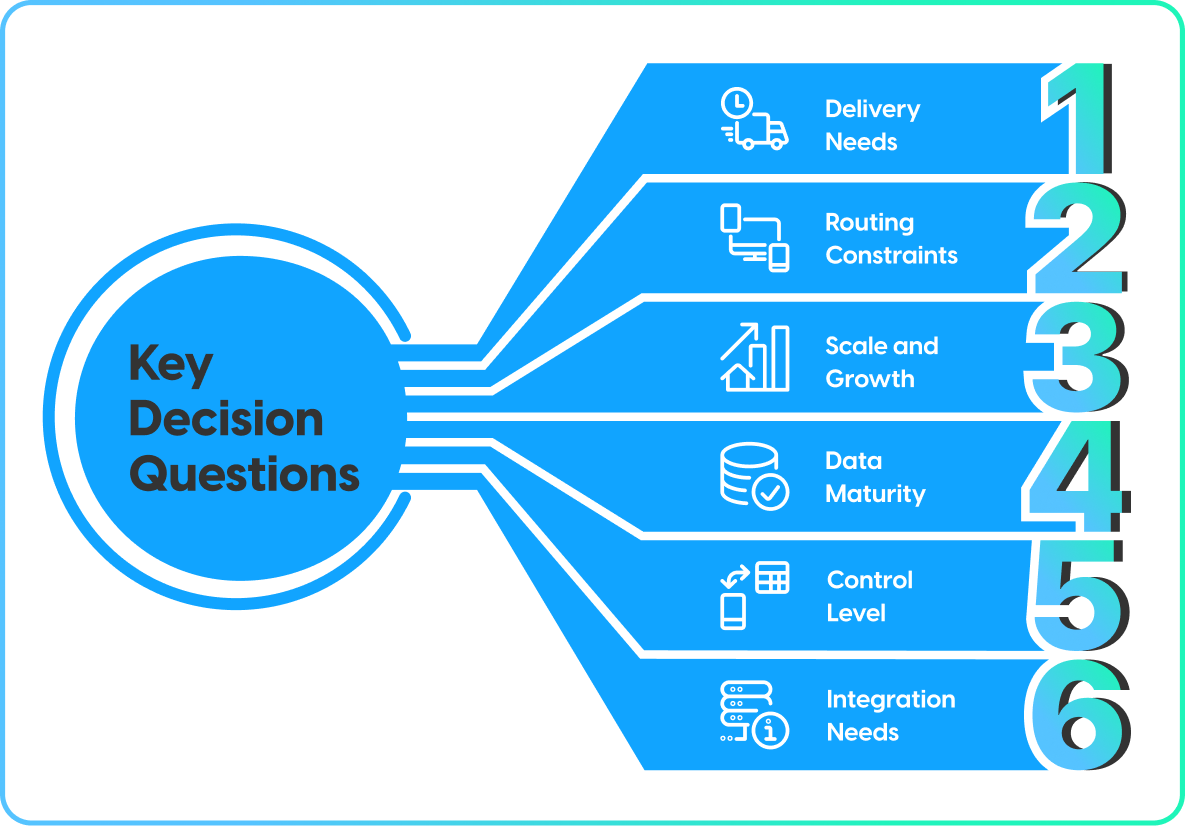
Key decision questions:
- Will you need on-demand delivery as well as scheduled postal deliveries?
- Do ULEZ requirements, dense city centers, and ESG targets require multimodal routing that includes EV vans, cargo bikes, and walking routes?
- What is your scale and growth trajectory over the next 3–5 years?
- How mature is your operational data (addresses, geocodes, service standards, scan events)?
- Do you need real-time control for replanning, exception management, etc., or primarily strategic planning and territory design?
- What integration is required with your existing stack (ERP, OMS, TMS, WMS, CRM, scanners, GIS)?
The best solution for postal operators looking to optimize and modernize postal services is the one that fits your operational complexity now and in years to come.
Focus on delivering measurable ROI via efficiency gains, lower cost per delivery and overall ops cost, better pick up/drop off success rates, higher capacity utilization, fewer miles driven, improved service levels, and the flexibility to adapt as volumes and customer expectations evolve, while not compromising support when needed.



Table of сontents