


Fleet and mobility operations have become one of the clearest places where business performance is won or lost. Hundreds of decisions determine whether an operation scales smoothly or creates more complexity. That is why The Optimizers Awards were created: to recognize the teams and leaders turning operational complexity into measurable progress across fleet, mobility, transportation, rental, delivery, AV, and beyond.
In the 2026 Optimizers Awards, the AI-Powered Operations Award goes to Karmo, an Australia-based car subscription company that stood out for using an AI to support its growth, doubling its fleet to more than 3,000 vehicles while improving utilization from 89% to 91%.
We spoke with Laura Harewood, Chief Revenue Officer, about Karmo’s subscription model, the operational thinking behind its growth, and how AI is becoming a practical optimization layer in procurement, fleet planning, customer experience, and future automation.
First, congratulations. Can you introduce yourself and Karmo?
I’m Laura Harewood, Chief Revenue Officer for Karmo. I’m based in Melbourne, Australia, and Karmo is a car subscription company operating across major Australian states, including Perth, Brisbane, Sydney, Melbourne, and Adelaide, with more expansion planned.
Our customers commit to a minimum of four months' period and experience a brand new car. They can change their vehicle as their life changes. It gives people access to mobility without the long-term commitment of ownership or traditional leasing.
We sit between traditional leasing and short-term car rental. It is not hourly car sharing, and it is not a long lease. It is a medium-term mobility product built around flexibility.
The way we work creates many optimization opportunities for businesses. Companies with contract workers, probationary employees, or short-term projects do not always need permanent fleet capacity. With a subscription, they can procure vehicles as needed and reduce idle fleet time. In fleet operations terms, it is about matching asset supply to real demand instead of carrying unnecessary capacity.
How does Karmo use AI?
A lot of our AI work is focused on fleet and customer understanding. We use AI to track the market, historical trends, consumer media, and supply signals from different brands. It is not a crystal ball, but it helps us understand what is happening and make better decisions.
That matters because Karmo works closely with dealers and manufacturers. We purchase vehicles, operate them in the subscription fleet, and then return them in a way that helps maintain residual values and brand reputation. So procurement is not just about getting vehicles onto the fleet. It is about choosing the right vehicles, at the right time, with the right lifecycle strategy.
That is the optimization angle: AI is helping Karmo turn market noise into better planning decisions.
What has been the biggest challenge in applying AI operationally?
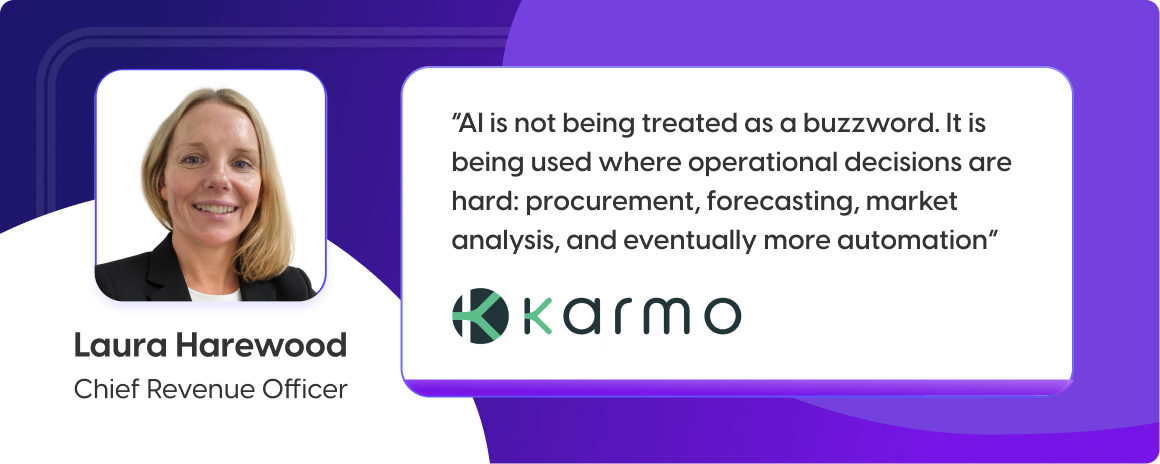
The challenge is feeding it accurate information so you get the output you want. You have to spend time educating the AI and refining how you use it. Everyone is busy, but that investment pays off. Our Chief Product Officer, Sam Zammit, really encourages us to get into it, and it is already paying off.
For Karmo, AI is not being treated as a buzzword. It is being used where operational decisions are hard: procurement, forecasting, market analysis, and eventually more automation across call center workflows, fleet management, and vehicle refreshes.
What KPIs guide the operation?
Procurement is a major KPI, including how we work with dealers and manufacturers on both purchasing and vehicle returns. Another important KPI is the customer handover experience. We want people to feel like they are getting a new car experience, not standing in a rental queue or focused on financing like in a leasing process.
Karmo keeps vehicles in the fleet for an average of about nine to ten months, which means customers often get access to nearly new vehicles. From an optimization perspective, that lifecycle matters. It helps balance customer experience, maintenance avoidance, registration timing, and residual value protection.
How has the company scaled while keeping the operation stable?
Karmo has consistently been scaling since its conception in 2019. A major moment was the acquisition of Motopool nearly two years ago, which made Karmo the clear number one car subscription company in Australia. We maintained growth, kept staff turnover low, and preserved the culture through that process. Karmo now has just under 100 team members and a strong focus on product and software.
The toughest part is keeping up with market trends. Australia has traditionally been loyal to brands like Ford and Toyota, but the market is changing with more overseas-made cars, shifting consumer preferences, and volatility in EV supply. The way through it is constant procurement discipline and close communication with dealers and OEMs.
What is next for Karmo operationally?
We have more growth plans. We recently announced work with AGL, an energy company in Australia, to drive their EV subscription offering. This opens the door to vehicle-to-grid opportunities and other future energy-related models.
At the start of this year, Karmo announced being the first novated subscription company in Australia. This brings all the salary tax benefits to the employee and staff benefits for the employer as a novated lease without the long-term commitment, this is a major operational focus right now.
Where do you see the industry going over the next three to five years?
The industry is moving fast. EVs, autonomous vehicles, and AI will all keep growing. Karmo wants to stay at the forefront, remain number one in Australia, and eventually expand internationally.
The next phase of AI is predictive. Karmo is building toward a fleet that effectively plans itself: forecasting demand by market, projecting vehicle volumes, timing purchases to supply and price, and orchestrating the rotations and swaps that keep customers in near-new cars. The residual value model in pilot today is the first piece of that. The goal is a procurement and lifecycle engine that knows what to buy, when to buy it, and exactly how long to hold it before the value curve turns.
That is what makes Karmo's story such a strong fit for the AI-Powered Operations Award. Karmo is not bolting AI on as a layer of complexity. As Sam Zammit explains, “We are building the data foundations now, ahead of the curve, so that AI sharpens the decisions that define the business: what vehicles to bring in, how long to hold them, how to protect residual value, and how to match supply to real demand instead of carrying idle capacity. That is what practical, durable AI in fleet and mobility operations looks like, and it is how Karmo intends to stay number one in Australia and take the model international.”
Karmo’s optimization story is ultimately about control: knowing what vehicles to bring in, how long to hold them, how to serve customers well, how to work with dealers, and how to scale without letting complexity overtake the operation. That is what practical AI in fleet and mobility operations looks like.
Read more winners' stories here.


Table of сontents
.avif)
.avif)


