
As VP Business at Autofleet, my role is to ensure the long-term success of our partners and clients and ensure they get the most value from Autofleet’s products. I have the privilege of working with fleet executives from various fleet and mobility industries, including ride-hailing, last-mile delivery, car-sharing, and rental operations. Over the course of many meetings, I've learned a great deal, and now I’d like to share those lessons with our readers and help you plan for a successful tech implementation in the future.
One key insight is that although dashboards provide visibility, they don't offer true control over operations. To get the best results and unleash what I call a fleet’s “superpower,” pairing operational goals with continuous optimization and automation is what brings the best impact on performance.
This is not a one-and-done effort; you won't transform your operation overnight, nor should you want to. Continuous optimization is the way forward, and that takes time, collecting data, and getting a deeper understanding of the business.
However, once the right partner and groundwork are in place, the true potential of the fleet is revealed. Allowing executives to tie the optimization platform directly to Key Performance Indicators (KPIs), whether that's lowering cost per task/ride/delivery, improving Service Level Agreement (SLA) compliance, increasing utilization, meeting demand, or reducing deadhead miles.
Here are some real-world examples of the approach we employ at Autofleet to ensure a fleet’s “superpower” comes to the fore.
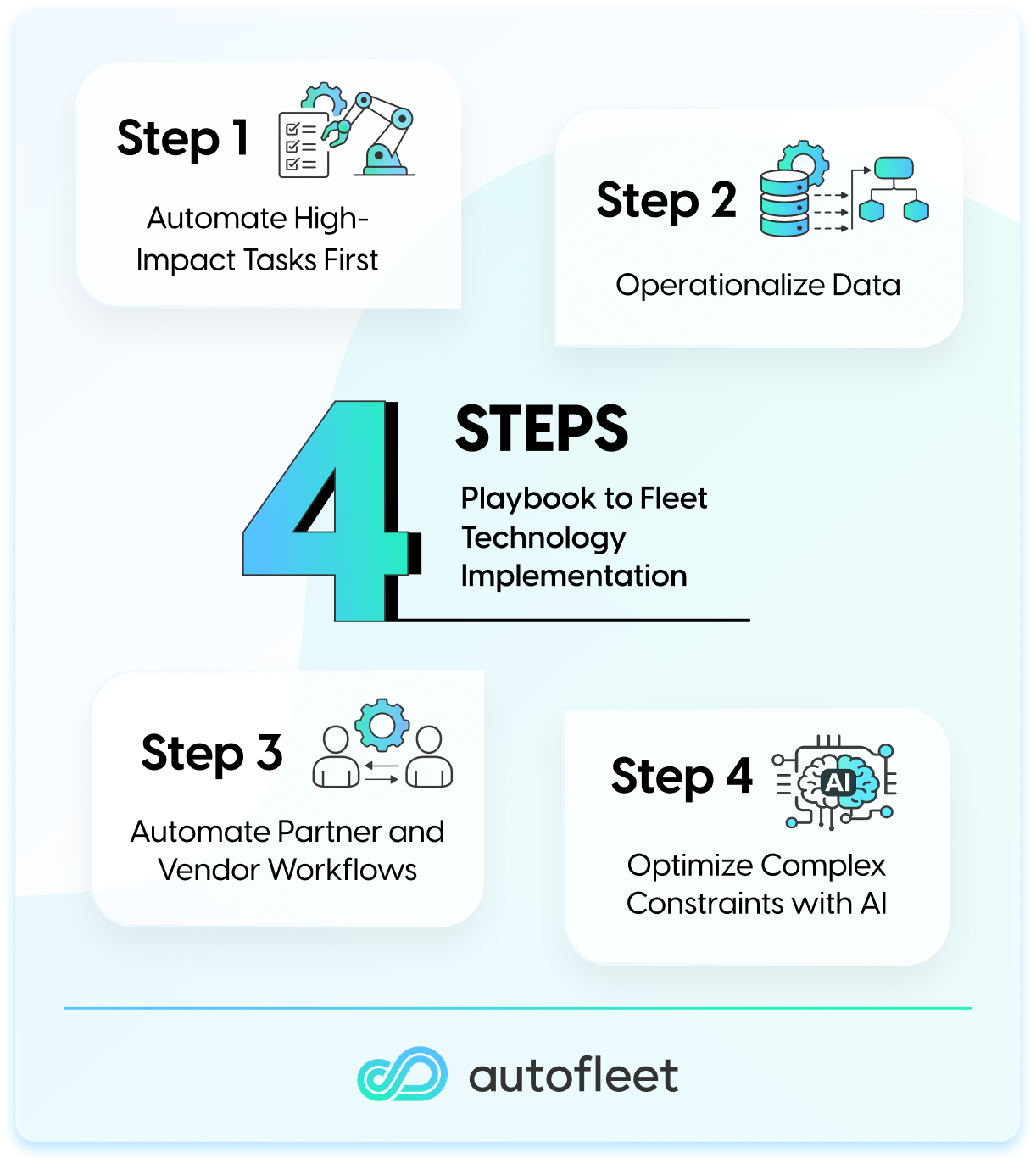
Step 1: Automate High-Impact Tasks First
The first step of onboarding is always the discovery phase, where Autofleet’s Implementation team works closely with the relevant stakeholders to understand the needs of the business, its challenges, opportunities for optimization, and existing workflows. From there, we often take a phased approach as we implement new technological tools in the fleet, starting with automating the manual daily actions that influence efficiency the most. This doesn't mean control or visibility are sacrificed, quite the opposite, actually. Automating highly manual tasks allows the operations teams to get alerts on urgent issues they need to tackle first, while always having full control over the operation in real time.
One such example is often driver dispatch, a task that used to be manual and that can be optimized and managed by the platform. This takes into account different data sets such as availability, state of charge, shifts, traffic patterns, and forecasted demand. Working with one leading food delivery provider, we were able to reduce dispatch time by an astounding 81%, for example, and on many other occasions, the new, optimized, and automated solution means a sharp increase in accuracy, reaching well over 95% On-Time Performance (OTP).
Step 2: Operationalize Data
Once we reap the benefits of these early optimizations, it is time to get data out of the dashboard and put it to operational use. This may come as a surprise, but I've found that although centralizing data gives executives visibility, it is often not activated, creating a huge missed opportunity to create more efficient operations.
Using data or AI to power tasks such as:
- Re-optimizing routes when traffic changes,
- Redistributing demand when a vehicle shows a fault
- Booking maintenance for a vehicle when a threshold is reached.
Frees the staff from making routine decisions to monitoring live operations and handling the exceptions that genuinely need human judgment.
Of course, no two fleets are the same, and when turning data into operational actions, we make sure the decision on how to run automations and use AI accounts for each fleet’s needs.
Sometimes that means running automations at 5 pm, so drivers receive next-day routes before dinner. Other times, it means triggering workflows in the morning, once final vehicle availability is known. The system is designed to adapt to how the fleet operates, not the other way around.
A strong example from my experience involves a B2B rental provider used by major delivery companies. Traditionally, vehicle rental required a field agent on-site to hand over keys and conduct vehicle inspections. But delivery companies often need the vehicles at very short notice, and in ungodly hours. So we replaced the old manual rental process with an automated one that also includes keyless vehicle access. Drivers use an app to view their reservation, complete a digital checklist that can trigger automations, and unlock the vehicle, anytime, day, night, or weekend.
This applies to electrified fleets as well, where EV charging optimization and state-of-charge monitoring ensure vehicles are ready when and where they're needed without impacting utilization
I’ve also seen the data used to enable improved anomaly detection and issue resolution. The optimization platform identifies problems, alerts the right people, and triggers workflows to keep operations on track.

Step 3: Automate Fleet Partner and Vendor Workflows
With data powering operations, the next step is to expand how it is used. In my work, optimization extends to partner and vendor management, not just the fleet itself. That not only provides better visibility and control, but can also prove critical to fleets that are sensitive to uptime, like car-sharing or rental. And because every fleet operates differently, I've learned there's no one-size-fits-all approach. I work with each organization to tailor workflows to its structure, KPIs, and operational constraints.
A good example involves automating task allocation to vendors responsible for vehicle cleaning for Zipcar, a car-sharing operation with over 10,000 vehicles in the US. When the vehicle cleaning process was rationalized and automated, the number of cleaning requests was cut by over 25%, and Net Promoter Score (NPS) scores actually went up.
This removes bottlenecks, improves asset availability, and unlocks large-scale growth without adding headcount.
Step 4: Optimize Complex Constraints with AI
Getting a fleet to perform at top performance is an ongoing effort, and operations need to constantly adapt and optimize. Using predictive demand modeling and dynamic resource optimization ensures the system scales with operational complexity. I worked with a paratransit provider that serves as a good example of this approach.
Our client expanded by buying a second operator. This expanded the workload with hundreds of daily rides across various programs with different strict rules. Creating a situation where a wheelchair rider from one program could not share a vehicle with passengers from another program. The platform had to sequence drop-offs and pickups using configurable settings to keep programs separate without wasting capacity.
This wasn't just a routing issue; it was a constraint-management challenge. By bringing all those rules into the platform, Autofleet optimized routing and scheduling to match business needs. The system understands which rides can be pooled, which must remain isolated, which drivers are eligible for which passengers, and how to re-sequence trips to stay compliant without losing utilization.
How to Get Started with Fleet Automation and Continuous Optimization
Across every step, we ensure human-in-the-loop guardrails to keep operators in control. The system handles routine decisions, while humans oversee exceptions.
In my experience, the fleets that succeed aren't the ones that buy software and hope for the best. They're the ones that use partner like us at Autofleet to continually improve across the board, be it planning, vendor management, EV charging strategies, or maintenance.
Optimizing fleet operations cannot be done in one fell swoop, and large fleets running complex operations should not expect to just buy a piece of software and be done. Rather, a phased launch program with continuous improvement to key KPIs and incremental implementation can create huge cumulative change over the span of a few months.
If your goal is to improve cost per task, increase utilization, consistently hit SLAs, or scale without adding headcount, I encourage you to explore how optimization platforms can unlock your fleet's potential. I'm happy to discuss how this approach might work for your specific operation.


Table of сontents